


ReactJS development outsourcing is the practice of contracting an external engineering team to design, build, and scale modern web interfaces using the ReactJS ecosystem, enabling companies to deliver high-performance front-end applications without expanding their internal development team. This model allows organisations to access specialised React expertise while accelerating product delivery and maintaining flexible development capacity.
Companies outsource ReactJS development because modern front-end systems require deep expertise in component-based architecture, state management, performance optimisation, and seamless integration with APIs and cloud-based backends, capabilities that many generalist development teams lack at production scale.
ReactJS outsourcing through Groove Technology covers eight service areas: React web application development, Progressive Web Apps (PWAs), front-end architecture design, API integration and backend connectivity, UI/UX implementation and design systems, migration to React, React staff augmentation and dedicated teams, and React Native app development. Each service is delivered using a modern React ecosystem including React.js, Next.js, Remix, TypeScript, Redux Toolkit, Zustand, Material UI, Tailwind CSS, GraphQL, React Query, Jest, Cypress, Vite, and cloud deployment through CI/CD pipelines on AWS, Vercel, and Netlify. Engagements are structured through two models, Dedicated Team and Staff Augmentation, and delivered through a nine step process that spans from requirement analysis to post launch optimisation and long term support.
With 10+ years of global delivery experience, 230+ engineers, 120+ completed projects, and a 97% client retention rate serving clients across Australia, the UK, and Europe, Groove Technology delivers scalable ReactJS applications with enterprise-grade engineering standards under ISO 27001-certified data handling.
This article explains why companies outsource ReactJS development, the services and technologies provided by Groove Technology, the 9-step outsourcing process, and real-world React projects that demonstrate how outsourced teams deliver production-ready web applications.
Why Do Companies Outsource React.js Development?
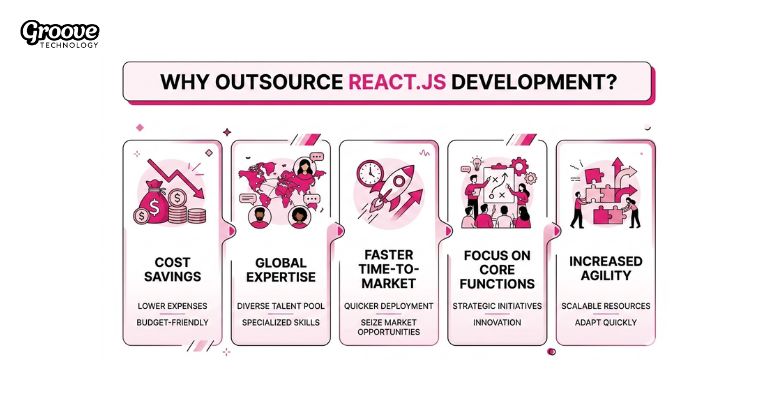
Companies outsource ReactJS development to build modern web applications faster while avoiding the cost and complexity of expanding internal engineering teams. Five key advantages drive this decision: cost savings, access to global React expertise, faster time-to-market, the ability for internal teams to focus on core business functions, and greater agility in scaling development resources as project needs evolve.
1. Cost Savings: Outsourcing React.js development provides a budget-friendly alternative to hiring in-house. It significantly cuts costs related to recruitment, onboarding, and infrastructure. For instance, a mid-sized project can cost about $50,000 with an outsourced team, while it may exceed $100,000 with in-house developers due to salaries and overhead.
2. Access to Global Expertise: Partnering with a React.js development company opens access to a diverse talent pool. This allows businesses to leverage specialized skills and innovative solutions from developers worldwide, ensuring the right expertise for various challenges.
3. Faster Time-to-Market: Outsourcing accelerates project timelines. Specialized agencies have efficient workflows and experienced teams, eliminating delays from hiring and training. This leads to quicker deployment, allowing companies to seize market opportunities and gain a competitive advantage.
4. Focus on Core Functions: Delegating React.js development enables companies to focus on strategic initiatives and innovation. By outsourcing technical tasks, internal teams can concentrate on product development and customer engagement, enhancing overall business efficiency.
5. Increased Agility: Relying on specialized agencies helps organizations remain agile, adapting swiftly to market demands and fostering growth. This approach minimizes the need for in-house infrastructure and training, streamlining operations and reducing overhead costs.
>>> See more: Outsourcing Software Development Pros and Cons You Need to Know in 2025
What React.js Development Services Does Groove Technology Deliver?
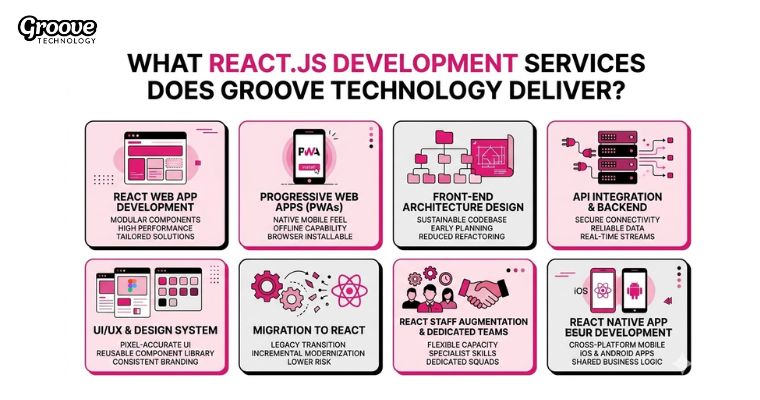
Groove Technology delivers 8 React.js outsourcing services covering the full product lifecycle — from custom web application builds and PWA delivery to front-end architecture, API integration, migration, and dedicated team models. Each service addresses a distinct phase of React.js development, giving businesses a single outsourcing partner across the entire stack rather than managing multiple vendors.
React Web Application Development
Groove Technology provides businesses the option to outsource ReactJS web app development services, delivering modern web applications using React.js and TypeScript with performance, flexibility, and long-term scalability. The codebase is structured around modular components, making the system easier to maintain and evolve throughout a multi-year product lifecycle.
A React web app engagement may include Single Page Applications (SPAs), data-intensive dashboards, customer portals, or e-commerce front-end systems. Rather than relying on templated delivery models, each solution is tailored to the client’s specific product goals and business requirements.
Unlike traditional websites that reload the entire page upon user interaction, React updates only the components that change through its Virtual DOM mechanism. In well-optimized builds, interaction response times can stay below 200ms, compared to 600–900ms in server-rendered systems that trigger full page reloads. This performance difference becomes especially noticeable in data-heavy dashboards, SaaS platforms, and highly interactive web products.
Progressive Web Apps (PWAs)
A Progressive Web App (PWA) delivers a native-like mobile experience without requiring distribution through app stores. When building PWAs with React, we integrate service workers, Web App Manifests, and intelligent caching strategies to ensure fast loading, offline capability, and installability directly from the browser.
Compared to native mobile development, PWAs typically shorten delivery cycles by 30–40% due to maintaining a single codebase. It also shortens time-to-market and lowers user acquisition friction since installation through an app store is not required. PWAs are particularly effective in industries such as retail, media platforms, logistics operations, and field service solutions where users frequently switch between desktop and mobile devices.
Front-End Architecture Design
Front-end architecture design directly impacts how scalable and maintainable a React application remains over a 2–3 year lifecycle. Early decisions regarding component hierarchy, state management, and data flow directly impact scalability, maintainability, and long-term development efficiency.
In mid-scale projects, a well-designed React architecture can reduce future refactoring effort by 40–60% at the 12-month audit mark. The impact becomes even more visible during team expansion: undocumented and flat component structures often require 3–4 weeks for onboarding, while a properly documented atomic system enables senior React developers to reach full productivity within 5–7 working days.
API Integration & Backend Connectivity
A React application performs reliably in production only when its API integration layer is properly engineered. React connects to backend systems through RESTful APIs, GraphQL endpoints, or real-time WebSocket streams, and the quality of this integration determines how well the front end handles data under load.
We integrate React front ends with existing backend services, third-party platforms, and internal APIs using tools such as Axios, React Query, or Apollo Client depending on data-fetching patterns. The choice of tooling is driven by data behavior including request frequency, caching strategy, real-time synchronization, and query complexity, rather than technical preference.
UI/UX Implementation & Design System
We convert Figma or Adobe XD designs into responsive, pixel-accurate React components, then organise those components into a shared design system for consistent UI delivery across the product. A design system built on React typically covers typography tokens, colour variables, spacing scales, and a component library, published via Storybook and versioned through npm for use across multiple front-end teams.
The gap between a design handoff and a working design system is where most outsourcing engagements lose time. Our implementation process begins with a component inventory, cataloguing all UI patterns in the design file, before any code is written. This helps prevent duplicate components and naming conflicts that can grow over time in codebases with more than 50 shared elements.
Migration to React
React migration involves transitioning an existing front-end codebase from AngularJS, jQuery, Backbone, or plain JavaScript to a modern React architecture to improve rendering performance, developer velocity, and long-term maintainability.
Instead of a full rewrite, we execute migrations in phases. The legacy application remains live while React components gradually replace outdated modules. This incremental approach minimizes deployment risk and business disruption.
React Staff Augmentation & Dedicated Teams
React staff augmentation places our engineers directly into a client’s existing development team, operating within the client’s sprint cycles, tools, and delivery cadence. This model is ideal for product teams with an established React codebase that require additional capacity, such as a senior React engineer, a TypeScript specialist, or a front-end performance expert for a defined period.
A dedicated React team, by contrast, is a fully outsourced squad – typically 3–6 engineers covering front end, back end, and QA – assigned exclusively to the client’s product. This model suits companies building a new React product from scratch or running parallel development streams alongside internal teams.
Both models operate under transparent time-and-materials or fixed monthly pricing structures, with no minimum commitment beyond a two-week onboarding period.
React Native App Development
React Native extends our React expertise into cross-platform mobile development, enabling the creation of iOS and Android applications from a shared JavaScript codebase while still allowing access to native device APIs when performance demands it. When web and mobile products are developed in parallel, approximately 70–80% of business logic can be shared between React web and React Native, significantly reducing total development cost compared to fully separate builds.
React Native is well suited for products where time-to-market and cross-platform consistency matter more than native-only performance optimization. However, for applications requiring high frame-rate graphics, AR capabilities, or intensive on-device processing, fully native development remains the more appropriate choice. We clarify this distinction during technical consultation before any development commitment is made.
How Does Groove Technology’s React.js Outsourcing Process Work?
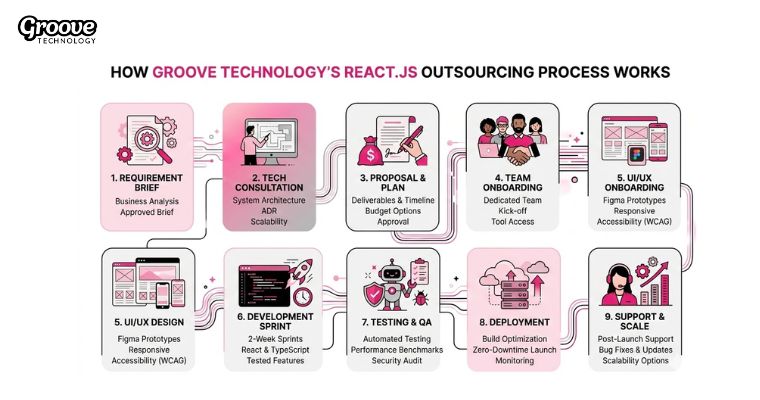
Groove Technology’s React.js outsourcing process runs across 9 phases, from requirement brief to post-launch support, structured so clients have defined decision points and clear deliverables at each stage, without needing to manage day-to-day development activities directly.
Phase 1: Requirement Brief
The engagement begins with a structured discovery session where our Business Analysts and Technical Leads analyze business objectives and translate them into clear functional and non-functional requirements. This includes defining user journeys, business logic, performance expectations, and integration dependencies.
The outcome is a comprehensive requirements brief covering functional scope, preliminary data models, integration touchpoints, and performance benchmarks. The document is reviewed and approved by the client before architecture design begins, serving as the single source of truth for scope decisions throughout the project.
Phase 2: Tech Consultation
Based on the approved requirements, our React architects design a scalable system architecture aligned with long-term product goals. This includes selecting the appropriate rendering model (CSR, SSR, or static generation via Next.js), defining the state management strategy, and planning the deployment infrastructure.
This phase produces an Architecture Decision Record (ADR), a high-level component structure, and a detailed integration plan covering API contracts and third-party services. For clients with an existing tech stack, we conduct a compatibility audit to identify potential technical constraints before development is scoped.
Phase 3: Proposal & Plan
Once the architecture is defined, we present a detailed written proposal outlining deliverables, sprint schedule, acceptance criteria, and either a fixed or capped budget.
Development only begins after formal client approval. For projects with evolving requirements, a time-and-materials model is structured with milestone checkpoints every 2–3 sprints, ensuring cost visibility while maintaining flexibility.
Phase 4: Team Onboarding
After project approval, a dedicated React team is assembled according to the technical requirements. The team typically includes front-end engineers, a backend integration specialist (if required), a QA engineer, and a project lead. A formal kick-off session establishes sprint cadence, communication channels, and tooling access (Jira, Slack, GitHub). Onboarding typically takes 3–5 working days for most projects.
Phase 5: UI/UX Design
Based on the approved requirements, the design team translates business logic into structured wireframes and then into high-fidelity Figma prototypes. The designs are iterated through multiple feedback cycles with the client before development begins.
Interfaces are built for standard breakpoints: desktop (1440px), tablet (768px), and mobile (375px), ensuring consistent responsiveness across devices. Accessibility compliance follows the WCAG 2.1 AA standard to support inclusive user experiences.
Phase 6: Development Sprint
Our engineers execute development in structured two-week sprints using React.js, Next.js, Remix, and TypeScript based on the approved architecture. Each sprint delivers fully functional, tested features rather than partial components, ensuring measurable progress at every stage.
All code undergoes senior-level peer review, ESLint validation, and inline documentation before merging. We provide a sprint demo at the end of each cycle and maintain a continuously updated staging environment so clients can review features in real time.
Phase 7: Testing & QA
Our QA process runs in parallel with development from sprint one. We implement automated testing using Jest, React Testing Library, and Cypress to cover unit, integration, and end-to-end scenarios, ensuring stability throughout the lifecycle.
We validate performance using Lighthouse benchmarks with target scores of 90+ for Performance, Accessibility, and Best Practices. Security testing follows OWASP Top 10 standards, and penetration testing is included for projects involving sensitive data or financial transactions.
Phase 8: Deployment
Our DevOps engineers manage production deployment, including build optimization, environment configuration, CDN setup, and zero-downtime releases to AWS, Vercel, Netlify, or the client’s infrastructure.
Before each release, we validate rollback procedures in staging. After deployment, we monitor the system for 48 hours to identify and resolve any production-specific issues before formal acceptance.
Phase 9: Support & Scale
We provide structured post-launch support that covers bug fixes, dependency updates, performance monitoring, and feature enhancements. Clients can engage us through a monthly retainer or on-demand model depending on operational needs.
Each client receives a dedicated support contact with SLAs of four business hours for critical issues and one business day for standard requests. When scaling is required, we initiate a structured requirements review to ensure technical alignment and controlled expansion.
Why Choose Groove Technology for ReactJS Outsourcing?
At Groove, we provide top-tier ReactJS outsourcing services. Our team combines expertise, agile methodologies, and flexible engagement models to ensure project success.
- Proven Expertise in ReactJS Development: With extensive experience, our skilled developers deliver innovative solutions across various sectors, including e-commerce, fintech, and healthcare. We stay updated with the latest ReactJS features to tackle complex projects effectively.
- Agile Development Methodology: We apply Agile methods, breaking projects into sprints for continuous feedback and quick adaptation. This approach enhances transparency and fosters collaboration, keeping projects aligned with business goals.
- Scalable and Flexible Engagement Models: We offer dedicated teams, time and materials, and fixed-price models to suit diverse client needs. Each model adapts to project scales and budgets, ensuring alignment with your objectives.
- Robust Quality Assurance Processes: Our multi-layered QA process includes automated and manual testing, integrated throughout development to catch issues early and ensure stable, high-quality applications.
- 24/7 Support and Maintenance: We provide ongoing support to keep your ReactJS application secure and efficient, addressing issues promptly to maintain optimal performance.

Successful ReactJS Projects at Groove Technology
Our client is a highly regarded chain of Mexican restaurants known for its vibrant atmosphere and exceptional cuisine. With a commitment to enhancing customer experiences, they sought to innovate their service delivery.
Challenge: The client needed a comprehensive and user-friendly app that could cater to a diverse range of ages and demographics. The existing system was cumbersome and did not effectively address customer needs, leading to dissatisfaction. To solve this, they partnered with us to create a streamlined platform that would enhance user engagement and simplify the ordering process through effective project management.
Our Solution: We developed a tailored food delivery app that not only showcases the restaurant’s signature dishes but also provides an intuitive interface for seamless navigation. By incorporating features such as personalized recommendations, real-time order tracking, and an easy payment process, we significantly improved customer satisfaction and retention in our web app development.
Technologies Used:
- Frontend: ReactJS
- Backend: Node.js
- Database: MongoDB
- Hosting: Amazon AWS
Frequently Asked Questions
What makes ReactJS ideal for modern web development?
ReactJS excels in modern web development due to its effective features. Its Virtual DOM improves UI performance, and reusable components simplify maintenance and scalability. The framework benefits from a large community, providing access to numerous libraries and tools. Functional components enhance readability, while PropTypes and React Developer Tools aid in error handling and inspection. Libraries like Immutable.js help maintain data integrity, making ReactJS a flexible choice.
How does outsourcing ReactJS development reduce costs?
Outsourcing ReactJS development reduces costs by eliminating recruitment, training, and long-term salary expenses. Companies gain access to skilled React.js developers without ongoing employment costs, lowering infrastructure and software fees. This approach allows for scalable resources, often resulting in project cost reductions of 30-50% compared to in-house work, faster time-to-market, and the ability to focus internal resources on core activities.
Can you scale the development team as per project needs?
Yes, we can scale our ReactJS development team based on project requirements. This flexibility allows for quick adjustments in team size. As demand grows, we can integrate skilled developers seamlessly. Conversely, if the project scope decreases, we can reduce the team size to optimize costs. Our pool of pre-vetted experts ensures you always have the right resources when needed.
How do you ensure code quality and security?
We ensure high code quality and security through rigorous processes. This includes thorough code reviews and automated tools for early issue detection. Our developers follow secure coding practices and stay updated on vulnerabilities. We use static code analysis to identify flaws and maintain a continuous integration pipeline with automated security scans. Regular audits and strong encryption protect sensitive data.
What are the future trends and insights of ReactJS?
Future trends in ReactJS include increased adoption of server-side rendering and static site generation for enhanced performance. React Server Components are emerging for quicker loads, while state management solutions like Recoil and Jotai gain traction as Redux alternatives. The integration of TypeScript improves type safety, and performance optimization through code splitting and lazy loading is essential. The focus on micro-frontends supports modular development, allowing us to leverage these trends for our clients’ benefit.
Conclusion
We’ve delved into the extensive advantages of outsourcing React.js Software Development Technology and how it can transform your business operations. Collaborating with Groove Technology will grant you access to our skilled professionals, established methodologies, and history of achievements.
Our aim is to provide innovative React.js solutions that propel your business forward. Seize the chance to optimize your potential. Join forces with us to develop outstanding React.js applications that will distinguish you in the highly competitive marketplace. Leverage our extensive software development expertise to further enhance your technological capabilities.

