


Node.js development outsourcing is the practice of contracting an external Node.js engineering team to build, extend, or maintain server-side JavaScript applications such as APIs, real-time systems, and microservices, enabling companies to access specialised backend expertise without building an internal engineering unit.
Companies outsource Node.js development because the runtime demands framework-level specialization in event-driven architecture, WebSocket management, and cloud-native deployment that generalist backend teams rarely carry at production depth.
Node.js outsourcing through Groove covers 7 service areas: web application development, API development and integration, microservices architecture, real-time application development, cloud-native solutions, legacy system modernization, and ongoing maintenance and performance optimization. Each service is delivered on a production-ready technology stack built around Node.js (LTS), Express.js, NestJS, TypeScript, Socket.io, Docker, Kubernetes, AWS Lambda, and Azure Functions. Engagement is structured through two models, Dedicated Team and Staff Augmentation, and delivered through a 9-step process that runs from the initial requirement brief to post-launch support.
With 10+ years of global experience, 120+ completed projects, and a 97% client retention rate serving clients in Australia, the EU, and the US, Groove Technology delivers production-grade Node.js systems at Vietnam-based rates, significantly below the $80–$150/hour for the North American market range.
This article covers why companies outsource Node.js development, the services and technologies provided by Groove Technology, the 9-step delivery process, and the reasons companies choose Groove Technology as their Node.js development partner.
Why Do Companies Outsource Node.js Development?
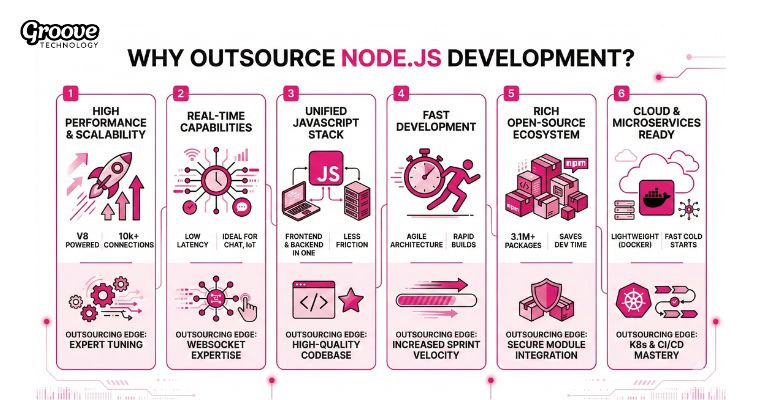
Companies outsource Node.js development to access a runtime built for high concurrency, real-time data transfer, and cloud-native deployment, without managing an internal engineering function. Six key advantages make Node.js the runtime that companies choose for outsourced backend work: high performance and scalability, real-time capabilities, a unified JavaScript stack, lightweight and fast development, a rich open-source ecosystem, and cloud and microservices readiness.
High Performance and Scalability
Node.js handles tens of thousands of concurrent connections within a single process without creating new threads for each request, making it one of the fastest options for high-traffic systems. This speed comes from Google’s V8 engine, which compiles JavaScript directly into machine code rather than reading it line by line, cutting execution time to sub-millisecond levels. For companies leveraging Node Js outsourcing outsource strategies, this means getting engineers who tune this architecture for production loads from the very first sprint, not after the system starts struggling under real user traffic.
Real-Time Capabilities
Node.js delivers instant data transfer between the server and client with near-zero latency by using non-blocking I/O, making it fast enough for chat platforms, live tracking dashboards, IoT data streams, and collaborative editing tools. This capability runs on a smart, continuous system that keeps the connection open and data flowing without creating a new background process for every single request. Outsourced Node.js teams bring hands-on Socket.io and WebSocket experience that in-house generalist developers rarely carry at a deep, production-ready level.
Unified JavaScript Stack
A unified JavaScript stack means one language covers both the frontend layer and the server-side logic. This eliminates context-switching costs between frontend and backend teams, reduces code-review cycles, and accelerates the development of shared modules. Outsourcing to a Node.js-specialized vendor means getting engineers who write consistent JavaScript (ES6+) and TypeScript across the entire application layer.
Lightweight and Fast Development
Node.js uses a non-blocking I/O model and an event loop that processes requests asynchronously, making it well-suited for data-intensive workloads without idle-thread overhead. Builds that might take weeks in Java or .NET environments take days in Node.js when the team knows the runtime well. Outsourced developers working in Node.js daily deliver faster iteration cycles, measured in sprint velocity rather than raw headcount.
Rich Open-Source Ecosystem
Node.js development runs on NPM, the largest open source package registry for any runtime environment, with over 3.1 million packages available. Each package represents pre-built logic that outsourced Node.js teams evaluate, integrate, and maintain without starting from scratch. This cuts feature development time by 30–50% on average for standard modules like authentication, data validation, and API gateway management.
Cloud and Microservices Ready
Node.js integrates directly with containerized and serverless environments, such as Docker images. They can achieve under 100 MB (about 3.5 oz in storage terms), and AWS Lambda cold starts for Node.js average 200 to 400 milliseconds. A reliable outsource Node Js development company like Groove Technology deploy Node.js services across distributed architectures using Kubernetes, CI/CD pipelines, and cloud-native patterns that scale individual services without touching the full system.
What Node.js Development Services Does Groove Technology Deliver?
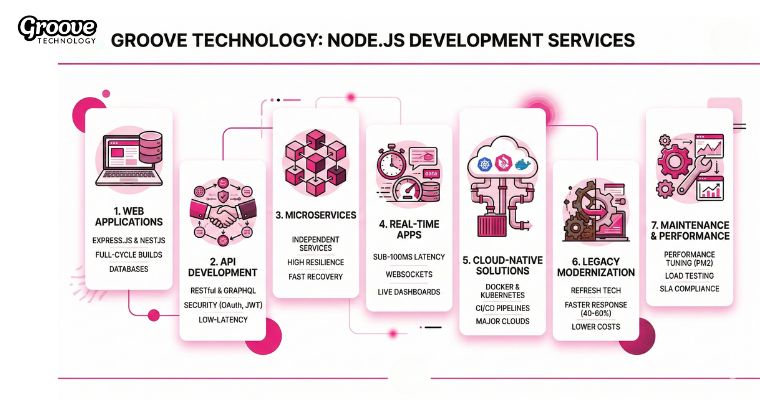
Groove Technology delivers 7 Node.js development services, spanning web application builds, API design, microservices architecture, real-time systems, cloud-native deployment, legacy modernization, and ongoing performance optimization. Each service maps to a specific engineering outcome, built on Node.js (LTS), Express.js, NestJS, Fastify, and a cloud-ready toolchain that supports production systems at scale.
Web Application Development
Web application development covers the full build cycle from server-side logic to frontend delivery, using a single runtime environment. Groove Technology engineers build fast, scalable web applications on Express.js for lightweight service needs and NestJS for structured, enterprise-grade architectures. Each application ships with modular routing, middleware configuration, and database integration for MongoDB, PostgreSQL, or MySQL, ready for production deployment on day one.
API Development and Integration
API development means designing data contracts that connect distributed systems, third-party platforms, and client applications with low latency and predictable behavior. We build RESTful and GraphQL APIs with JWT and OAuth 2.0 authentication, rate limiting, and auto-generated documentation via Swagger or Apollo. Each API endpoint handles structured request validation and error handling before leaving the server, helping reduce downstream integration failures by design.
Microservices Architecture
Microservices architecture breaks monolithic backends into independent, deployable services, each with its own data layer and communication interface. Groove Technology engineers design these services with clear domain boundaries, using event-driven messaging between components to prevent tight coupling. The result is a system where individual services scale or fail without affecting the rest of the application, where cutting mean time to recovery (MTTR) from hours to minutes.
Real-Time Application Development
Real-time application development targets systems where data must move from server to client in under 100 milliseconds, such as chat platforms, live tracking dashboards, push notifications, and collaborative editing tools. We implement persistent connections using WebSockets and Socket.io, with room management, event broadcasting, and reconnection logic built into the core architecture. Load testing with Artillery or k6 validates throughput before any real-time system goes live.
Cloud-Native Solutions
Cloud-native Node.js solutions cover deployment architecture, not just the application code. Groove Technology packages Node.js services into Docker containers, orchestrates them with Kubernetes, and wires CI/CD pipelines through GitHub Actions or GitLab CI for zero-downtime releases. Deployments run across AWS Lambda, Azure Functions, and Google Cloud Platform, with infrastructure-as-code configurations that replicate environments from staging to production without manual intervention.
Legacy System Modernization
Legacy system modernization addresses aging backends, including PHP monoliths, Java-based systems, or outdated REST services that block feature delivery and inflate infrastructure costs. We audit the existing codebase, map dependencies, and refactors service by service into a Node.js runtime, preserving business logic while replacing the execution layer. Clients typically see server response times drop by 40–60% and infrastructure costs reduce within 3 months of completing the migration.
Maintenance and Performance Optimization
Maintenance and performance optimization covers the application lifecycle after launch, including monitoring, debugging, profiling, and scaling as usage patterns change. Groove Technology uses PM2 for process management, Nginx for load distribution, and tools like k6 and Artillery for ongoing load testing against production traffic benchmarks. Response time targets, error rate thresholds, and memory usage limits are defined in SLAs, keeping Node.js systems operating within agreed performance margins at any traffic volume.
The seven Node.js development services above depend directly on the technologies behind them. The runtime, frameworks, databases, and DevOps tooling each team member works with daily determine how fast a system scales, how reliably it performs, and how much it costs to maintain at production load.
Groove Technology brings together Node.js web development and a modern, production-grade toolchain to build backend systems that scale alongside business growth. The table below maps each layer of the stack to the specific tools used across services.
Stack Layer | Technologies |
| Core Stack | Node.js (LTS), Express.js, NestJS, Fastify, Hapi |
Languages | JavaScript (ES6+), TypeScript |
| Real-Time Frameworks | Socket.io, WebSocket, GraphQL Subscriptions |
Database | MongoDB, PostgreSQL, MySQL, Redis, Cassandra |
| Authentication and Security | JWT, OAuth 2.0, Passport.js, Helmet |
Testing and Quality | Jest, Mocha, Chai, Supertest, ESLint |
| Cloud and DevOps | AWS Lambda, Azure Functions, Docker, Kubernetes, CI/CD pipelines |
Selecting the right technology stack is one decision. Choosing the right engagement model means choosing how the team is structured, managed, and contracted, and this choice has an equal impact on project outcomes. The two primary models Groove Technology offers for Node.js outsourcing are dedicated teams and staff augmentation, and each serves a different operational reality.
Dedicated teams and staff augmentation are two outsourcing models that differ in structure, management control, and the project scenarios each fits. A dedicated team functions as an extension of your internal workforce, fully assembled and managed by the vendor, while staff augmentation places individual specialists inside your existing team under your direct day-to-day management.
The table below compares both models across six decision-relevant dimensions.
Aspect | Dedicated Team | Staff Augmentation |
Team Composition | Complete units: developers, QA, PM, assigned exclusively to your project | Individual specialists (e.g., one Node.js backend developer) added to fill specific skill gaps |
Management | Client defines goals and priorities; vendor handles operations, HR, and scaling | Client retains full task control and workflow management |
Engagement Length | Long-term (months to years) with end-to-end delivery ownership | Short-term or project-phase specific; flexible entry and exit |
Cost Structure | Higher upfront commitment; predictable monthly fees with long-term cost efficiency through scalability | Pay-per-resource; lower entry point but variable month-to-month spend |
Flexibility | Scales as a unit; less suited for rapid single-role changes | Individual experts are added or removed quickly based on sprint needs |
Risk Profile | Vendor dependency; cultural and process alignment require early investment | Integration challenges: augmented engineers carry less project context |
Dedicated teams perform best on complex, multi-phase Node.js projects like scalable SaaS platforms, fintech backends, or MVPs that need sustained engineering continuity for Australian or EU companies building long-running products through Vietnam-based outsourcing partners. Staff augmentation, on the other hand, fits time-sensitive needs: adding a Node.js backend specialist to handle an API migration sprint or scaling up server capacity during a traffic surge, all managed directly through your own project workflow.
How Does Groove Technology’s Node.js Outsourcing Process Work?
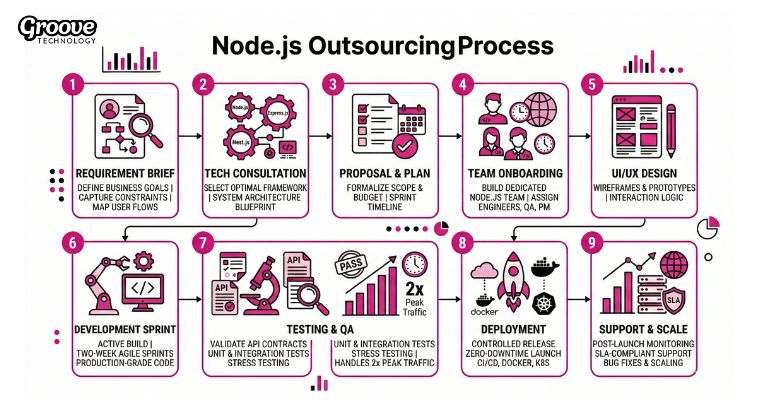
Groove Technology’s Node.js outsourcing process comprises 9 structured steps from the requirement brief and tech consultation through to deployment and long-term support. Each step produces a defined output that feeds directly into the next, keeping the project on schedule and technically aligned at every stage.
Step 1: Requirement Brief
A requirements brief is the structured capture of your business goals, system constraints, and expected outcomes before any technical decisions are made. Groove Technology’s engineers and business analysts interview key stakeholders, map user flows, and document functional and non-functional requirements, producing a brief that all subsequent architecture decisions reference.
Step 2: Tech Consultation
Tech consultation means selecting the runtime configuration, framework, and integration approach that fits your specific load profile and data structure. Groove Technology architects evaluate whether Express.js, NestJS, Fastify, or Hapi best suits your use case, then produce an architecture diagram covering service boundaries, database connections, and deployment targets.
Step 3: Proposal and Plan
A project proposal formalizes scope, delivery milestones, resource allocation, and total cost into a single reference document. Groove Technology presents itemized deliverables, a sprint-by-sprint timeline, and a budget breakdown with all costs fixed upfront and scaling terms agreed before work begins.
Step 4: Team Onboarding
Team onboarding assigns the engineers, QA specialists, and project manager who will own the delivery from kickoff through launch. Groove Technology forms a dedicated Node.js team matched to your stack, including backend engineers fluent in Node.js (LTS), cloud engineers familiar with your target platform, and a PM who runs standups in your time zone.
Step 5: UI/UX Design
UI/UX design covers the user-facing layer: screen flows, component hierarchy, and interaction logic before a single line of backend code ships. Our designers work from your business logic to produce wireframes and high-fidelity prototypes that developers implement directly, cutting rework cycles between design and engineering.
Step 6: Development Sprint
A development sprint is the active build phase in which Node.js engineers write, review, and commit production-grade code against the agreed-upon specification. Groove Technology teams build in two-week Agile sprints using Node.js (LTS), Express.js, NestJS, Fastify, or Hapi with code reviews, ESLint validation, and pull request approvals gating every merge into the main branch.
Step 7: Testing and QA
Testing and QA cover unit tests, integration tests, API contract validation, and load testing before any code reaches a staging or production environment. Groove Technology runs test suites with Jest, Mocha, Chai, and Supertest, with k6 or Artillery stress tests confirming that the system maintains target throughput under 2x expected peak traffic (approximately 2 times the production baseline load).
Step 8: Deployment
Deployment is the controlled release of the tested Node.js application to your production environment, server, or cloud platform. Groove Technology handles zero-downtime releases using Docker containers, Kubernetes rolling updates, and CI/CD pipelines with environment parity between staging and production, reducing post-launch failures by design.
Step 9: Support and Scale
Post-launch support covers monitoring, bug resolution, performance profiling, and capacity planning as real user traffic reveals the system’s actual load patterns. Groove Technology maintains Node.js systems using PM2 for process management and Nginx for traffic distribution, and scales horizontally or vertically based on SLA-defined response time and uptime thresholds.
Why Choose Groove Technology for Node.js Outsourcing?
Companies choose Groove Technology to get high-quality backend systems built by dedicated Node.js experts at Vietnam-based rates, saving up to 60% compared to Western prices without sacrificing quality. This is driven by deep technical knowledge, clear Agile sprints, a decade of global experience, strict security standards, and ongoing maintenance. Each reason maps to a specific operational outcome that affects how quickly and reliably a Node.js project reaches production.
- Proven Node.js Expertise: Groove Technology engineers work daily with Node.js (LTS), Express.js, NestJS, Fastify, and Hapi to build data-driven backend systems across fintech, logistics, and SaaS platforms. This depth of framework-level experience cuts architecture decision time and reduces integration risk from the first sprint.
- 10+ Years of Global Experience: Groove Technology has delivered many Node.js projects for clients in Australia, the EU, and the US, operating under data compliance frameworks that vary by region, including GDPR and the Australian Privacy Act. Over 120 completed projects and a 97% client retention rate reflect consistent delivery across time zones and regulatory environments.
- Agile and Transparent Process: Every Node.js engagement runs in iterative sprints with sprint reviews, documented velocity, and open access to the project backlog, so clients see progress and blockers in real time, not at milestone checkpoints. All costs are fixed upfront, with scope change processes defined before work begins.
- Performance and Security Focused: Groove Technology applies security controls at the code level, including JWT authentication, OAuth 2.0, Helmet middleware, and role-based access control (RBAC), alongside load testing with k6 and Artillery to verify performance under peak traffic before each production release. Node.js systems are certified against ISO 27001 data security standards.
- Cost-Effective Partnership: Node.js development through Groove Technology’s Vietnam-based engineering team is significantly lower than equivalent North American or Western European teams without reducing code quality, test coverage, or delivery speed. Ongoing maintenance and performance optimization are included in the engagement terms and are not billed as separate support contracts.

Frequently Asked Questions About Node.js Development Outsourcing
What Engagement Models Does Groove Technology Offer for Node.js Projects?
Groove Technology offers 3 engagement models for Node.js projects: a dedicated team for long-term, end-to-end delivery; staff augmentation for adding individual Node.js specialists to your existing team; and project-based contracts for fixed-scope builds with defined deliverables and timelines.
How Much Does Outsourcing Node.js Development Cost?
Node.js outsourcing rates range from $15/hour (approximately AU$23/hour) for South Asian teams to $150/hour (approximately AU$230/hour) or above for North American senior engineers and vary by region, team seniority, and project complexity. The table below shows average hourly market rates by geography to help set realistic budget expectations.
Region | Average Hourly Rate |
| North America | $80 – $150 |
The United Kingdom | $50 – $150+ |
| Western Europe | $60 – $120 |
Eastern Europe | $30 – $80 |
| Latin America | $25 – $70 |
India and South Asia | $15 – $60 |
(Source: Serviot)
How Does Groove Technology Protect Client IP in Node.js Outsourcing Engagements?
Groove Technology protects client intellectual property in Node.js outsourcing through legally binding Non-Disclosure Agreements (NDAs) signed before any project discussion, Intellectual Property Rights (IPR) clauses embedded in Master Service Agreements (MSAs) that assign full ownership of all deliverables to the client, and strict role-based access controls (RBAC) that limit code repository access to only the engineers working on that specific project. All systems operate under ISO 27001-certified data security standards.
Conclusion
Node.js outsourcing gives companies direct access to a high-performance backend runtime, a production-grade tech stack, and engineers who build real-time, cloud-native systems at scale without the overhead of in-house recruitment, training, or infrastructure management. Groove Technology brings over 10 years of global delivery experience, a proven 9-step process, and flexible engagement models to match any project scope or team structure. Fill in the contact form below to get a quote and discuss your Node.js project requirements with our team.

