


.NET development outsourcing is the practice of hiring an external company or team to design, build, maintain, or extend software applications on the .NET platform, including .NET Core, .NET 5/6/7/8, ASP.NET, Blazor, and MAUI, which enables companies to access specialized Microsoft stack expertise without building an internal engineering unit.
Companies outsource .NET development because the framework demands specialized expertise in enterprise-grade reliability, cross-platform flexibility, and native Azure integration that generalist development teams rarely carry at production depth for complex business applications.
.NET outsourcing through Groove Technology covers 7 service areas: custom .NET web application development, API development and integration, cloud-native .NET solutions, .NET migration and modernization, microservices architecture development, maintenance and performance optimization, and testing and quality assurance. Each service is delivered on a production-ready technology stack built around .NET 6/7/8, ASP.NET Core, Blazor, Entity Framework Core, C#, Azure, and xUnit. Engagement is structured through two main models, dedicated teams and staff augmentation, and delivered through a 9-step process that runs from the initial requirement brief to post-launch support and scale.
With over 10 years of global experience and a track record across 120+ projects serving clients in Australia, the EU, and the US, Groove Technology delivers production-grade .NET systems at cost-effective Vietnam-based rates of $18–$40 per hour, significantly below the $100–$200 per hour range for the North American market.
This article covers why companies outsource .NET development, the services and technologies provided by Groove Technology, the 9-step delivery process, and the reasons companies choose Groove Technology as their .NET development partner.
Why Do Companies Outsource .NET Development?
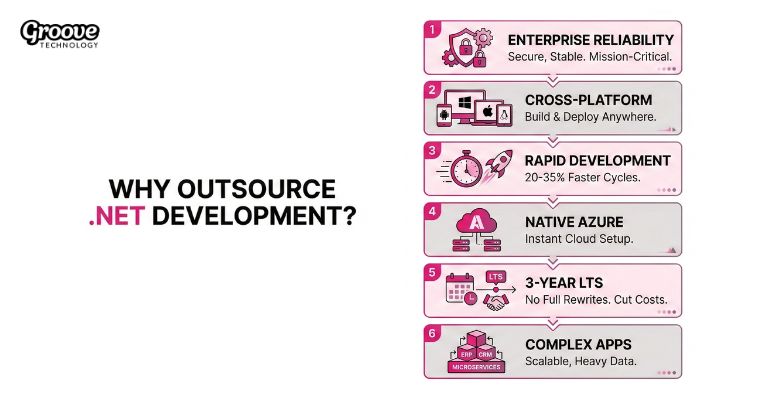
Companies outsource .NET development to access a platform built for enterprise-grade reliability, cross-platform flexibility, and native Azure integration, without managing an internal engineering function. Six key advantages make .NET the stack that companies choose for outsourced software development: enterprise-grade reliability, cross-platform and cloud readiness, rapid development with strong frameworks, seamless Azure integration, long-term support and backward compatibility, and suitability for complex business applications.
Enterprise-Grade Reliability
.NET supports mission-critical systems without performance gaps or security vulnerabilities, delivering true enterprise-grade reliability. This foundation is built and maintained by Microsoft, ensuring consistent runtime stability, built-in security controls, and official long-term support (LTS) cycles. For companies outsourcing the development of financial platforms, healthcare systems, or government applications, this means removing risk at the infrastructure layer before a single line of business logic is written.
Cross-Platform & Cloud-Ready
.NET runs the same codebase on Windows, Linux, and macOS without rewriting or branching, providing complete cross-platform compatibility. By unifying its runtime from .NET Core 3.1 through .NET 6/8, Microsoft enables seamless deployments across diverse operating systems and cloud environments, including Azure, AWS, and GCP. Companies outsourcing .NET development get teams that build once and deploy anywhere, reducing porting costs and accelerating time-to-market for global products across heterogeneous server environments.
Rapid Development with Strong Frameworks
.NET accelerates web application delivery by using ASP.NET Core and Blazor to streamline full-stack development without requiring separate JavaScript frameworks. ASP.NET Core provides a modular pipeline for RESTful APIs and server-rendered apps, while Blazor extends C# logic directly to the browser via WebAssembly. For companies outsourcing .NET projects, leveraging these reusable components, scaffolding utilities, and NuGet package integration reduces initial development cycles by 20–35% compared to greenfield setups with less mature ecosystems.
Seamless Azure Integration
.NET provides native compatibility with Microsoft’s cloud platform, delivering seamless Azure integration that entirely removes overhead at the DevOps and data layers. Services like Azure App Service, Azure Functions, Azure DevOps, and Cosmos DB all carry first-class pre-built .NET SDKs. By outsourcing to .NET teams, businesses can configure deployment pipelines, auto-scaling rules, and monitoring dashboards in Azure within hours rather than days, significantly cutting infrastructure setup time for cloud-first projects.
Long-Term Support & Backward Compatibility
.NET guarantees a reliable upgrade path through backward-compatible API design, allowing transitions from .NET Framework 4.8 to .NET 6 or .NET 8 without breaking core application logic. This stability is driven by Microsoft’s structured release policy, where each long-term support (LTS) version receives 3 years of security patches and performance updates. For enterprise projects with 5-10-year lifecycles, outsourcing .NET development ensures predictability, reduces modernisation costs, and enables teams to plan upgrades without full rewrites.
Ideal for Complex Business Applications
.NET seamlessly handles the data throughput and transactional integrity required for large-scale ERP, CRM, and enterprise platform development across regulated industries. The framework achieves this by combining support for Domain-Driven Design (DDD), CQRS patterns, and microservices architecture with SQL Server, Entity Framework Core, and gRPC for inter-service communication. When outsourcing complex business applications, this tech stack provides teams with the structural tools to build and maintain highly scalable systems that handle demanding business logic.
What .NET Development Services Does Groove Technology Deliver?
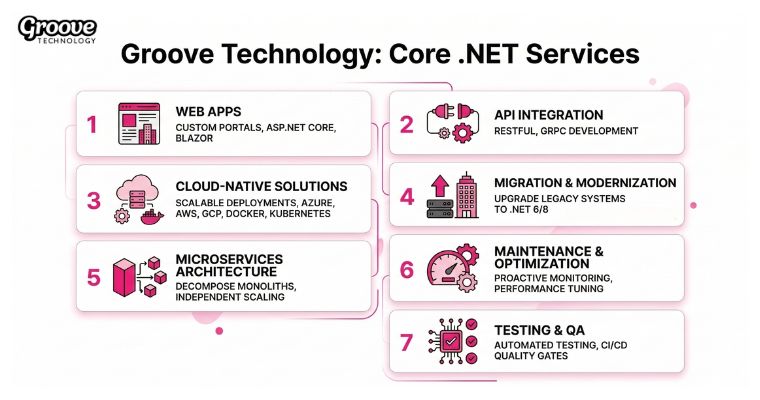
Groove Technology delivers 7 .NET development outsourcing services:
- Custom .NET Web Application Development
- API Development & Integration
- Cloud-Native .NET Solutions
- .NET Migration & Modernization
- Microservices Architecture Development
- Maintenance & Performance Optimization
- Testing & Quality Assurance.
Each service targets a distinct phase of the software lifecycle, giving your team access to specialised .NET expertise from design through to long-term production support.
Custom .NET Web Application Development
Custom .NET web application development refers to building purpose-built web platforms that align with specific business logic, user workflows, and performance requirements. Groove Technology’s engineers use ASP.NET Core, MVC, and Blazor to deliver secure, high-performance web applications, from customer-facing portals to back-office systems. Each solution is structured around your data models, integration points, and scalability targets rather than being adapted from generic templates.
API Development & Integration
API development and integration refers to designing and connecting the communication layer between your systems, mobile applications, and external services. We build RESTful and gRPC APIs using ASP.NET Core Web API, with Swagger documentation, OAuth 2.0 authentication, and structured error handling built in from the start. These APIs serve as the connective tissue across distributed systems, enabling stable data exchange at high request volumes without latency degradation.
Cloud-Native .NET Solutions
Cloud-native .NET solutions refer to applications designed from the ground up to run in cloud environments rather than adapted from on-premise architectures. Groove Technology deploys and manages .NET applications on Azure, AWS, and GCP using CI/CD pipelines, Docker containers, and Kubernetes orchestration for automated scaling and recovery. This approach reduces infrastructure overhead while giving your operations team full observability through platform-native monitoring tools such as Azure Monitor and AWS CloudWatch.
.NET Migration & Modernization
.NET migration and modernization refers to the structured process of moving legacy .NET Framework applications to current runtime versions (specifically .NET 6 or .NET 8) without disrupting active business operations. We conduct dependency audits, refactors incompatible APIs, and rebuilds data access layers using Entity Framework Core to produce a clean, cloud-compatible codebase. The result is a system with measurably lower memory consumption, faster cold-start times, and a maintainable structure that development teams can extend without architectural debt.
Microservices Architecture Development
Microservices architecture development refers to decomposing monolithic applications into independently deployable services, each owning a specific business capability and data domain. Groove Technology designs these services using Domain-Driven Design (DDD) and CQRS patterns, with gRPC or message brokers such as RabbitMQ and Azure Service Bus handling inter-service communication. This structure reduces cross-team dependencies, isolates failure domains, and enables individual services to scale based on actual load rather than whole-system provisioning.
Maintenance & Performance Optimization
.NET maintenance and performance optimization refers to the ongoing process of monitoring, refactoring, and improving live production systems to sustain speed, security, and uptime targets. We identify bottlenecks using profiling tools such as dotnet-trace and Application Insights, then apply targeted fixes, including query optimization, caching with Redis, and memory allocation improvements, to resolve performance gaps at their root. Regular security patching and dependency updates keep your system aligned with current .NET LTS standards without disrupting production deployments.
Testing & Quality Assurance
.NET testing and quality assurance mean the structured verification of code correctness, system stability, and integration reliability across all environments before and after deployment. Groove Technology implements automated test suites using xUnit, NUnit, and MSTest, integrated into CI/CD pipelines via Azure DevOps or GitHub Actions to enforce quality gates on every pull request. Code quality analysis through SonarQube identifies maintainability issues, security vulnerabilities, and test coverage gaps, which gives your team a defensible quality baseline that holds through each release cycle.
The services above reflect what Groove Technology builds, and the technology stack below reflects how. Selecting the right combination of frameworks, cloud platforms, and testing tools directly determines how well your .NET solution performs at scale, how quickly it can be maintained, and how confidently it integrates with your existing systems.
Groove Technology brings together .NET web development and modern cloud, database, and testing technologies to build solutions that scale reliably with your business. The table below covers the full stack across 8 categories.
Category | Technologies |
| Core Stack | .NET 6 / 7 / 8, ASP.NET Core (MVC, Blazor), Entity Framework Core |
Languages | C# (primary), VB.NET, F# |
| Architecture | Microservices, Clean Architecture, DDD, CQRS |
Cloud & DevOps | Azure (Azure Functions, App Service, Azure DevOps), AWS Lambda, Docker, Kubernetes |
| Database | SQL Server, PostgreSQL, MongoDB, Cosmos DB |
API & Integration | RESTful / gRPC APIs, GraphQL, Swagger, ERP & Payment Gateway integration |
| Front-End & Cross-Platform | Blazor, React, Angular, MAUI / Xamarin |
Testing & Quality | xUnit, NUnit, MSTest, SonarQube, CI/CD automation |
A clearly defined technology stack tells you what gets built and with what tools, but the engagement model determines who owns what, who manages whom, and how your organisation retains control. Choosing between a dedicated team and staff augmentation shapes every downstream decision about cost, pace, and accountability across your .NET project.
Dedicated teams and staff augmentation are two main outsourcing models that Groove Technology provide, but they differ in structure, control, and ideal use cases. A dedicated team acts as an extension of your internal workforce, fully managed by the vendor, while staff augmentation adds individual experts to your existing team under your direct management. Here is how the two models compare across the decisions that matter most.
Aspect | Dedicated Team | Staff Augmentation |
Team Composition | A complete cross-functional unit including developers, QA engineers, and a Project Manager that is assigned exclusively to your project | Individual specialists (e.g., one C# backend developer or one Azure architect) are placed to fill specific skill gaps |
Management | You set goals and priorities; the provider handles day-to-day operations, HR, and team scaling | You retain full control over tasks, workflows, and the daily direction of each resource |
Engagement Length | Best suited for long-term projects (months to years) requiring end-to-end ownership and consistent delivery | Fits short-term or time-bounded needs where targeted skill input is sufficient |
Cost Structure | Higher upfront investment with predictable monthly fees; long-term savings through team stability and scalability | Pay-per-resource billing with a lower entry point, though the total cost varies with usage |
Flexibility | Scales as a unit with structured team processes; less reactive to rapid scope changes | Individual experts can be added or removed quickly based on shifting requirements |
Risk | Vendor dependency is higher; cultural alignment and onboarding quality determine long-term performance | Integration into existing workflows can create friction; individual contributors carry less project context than embedded teams |
So, which one is the best fit for your business? You can choose a dedicated team for long-term, evolving .NET projects where you need a full cross-functional unit (developers, QA engineers, and Project Managers) managed and scaled by the vendor. On the other hand, you can choose staff augmentation for short-term skill gaps where you directly integrate individual .NET experts, such as C# backend developers or Azure cloud specialists, into your own team with minimal ramp-up time.
How Does Groove Technology’s .NET Outsourcing Process Work?
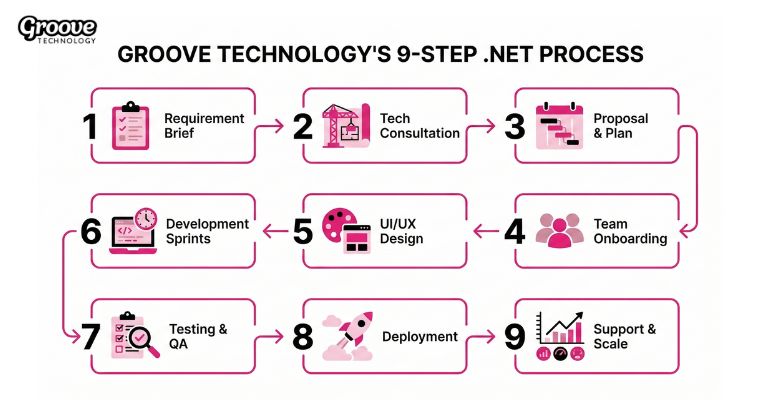
Groove Technology’s .NET outsourcing process comprises 9 structured steps, from Requirement Brief through to Support & Scale, covering architecture planning, team formation, development, and post-launch operations. Each step is designed to give your team clear visibility and control at every stage.
Step 1: Requirement Brief
A requirement brief is the structured capture of your business objectives, user needs, and technical constraints before any architecture decisions are made. Groove Technology’s business analysts map your workflows, data requirements, and integration points into a documented specification that every downstream team member works from.
Step 2: Tech Consultation
A tech consultation is the process of selecting the right architectural patterns, frameworks, and deployment environments for your specific solution. Our architects review your requirements and produce a technical design that covers framework versions, database choices, cloud targets, and API structures with a rationale documented for each decision.
Step 3: Proposal & Plan
A project proposal formalises the agreed scope into a time-bound, costed delivery plan with defined deliverables and milestones. Our architects review your requirements to produce a technical design that covers framework versions, database choices, cloud targets, and API structures, with a documented rationale.
Step 4: Team Onboarding
Team onboarding is the process of assembling and briefing the engineers who will own your project’s execution. Groove Technology forms a dedicated unit with backend C# developers, frontend engineers, cloud specialists, QA testers, and a Project Manager, each briefed on your codebase, tooling standards, and delivery expectations before sprint work begins.
Step 5: UI/UX Design
UI/UX design is the translation of your business logic and user workflows into screen-level interface patterns before development begins. Our designers produce wireframes and high-fidelity mockups based on your brand standards and user journey maps, with your team reviewing and approving each stage before any front-end code is written.
Step 6: Development Sprint
A development sprint is a fixed delivery cycle (typically 1 to 2 weeks) during which engineers build, review, and commit working features against the agreed specification. Groove Technology’s engineers write production-grade code using .NET 6/7/8, ASP.NET Core, Blazor, and Entity Framework Core, with pull request reviews and automated pipeline checks enforced on every merge.
Step 7: Testing & QA
Testing and quality assurance are the structured verification of code correctness, security posture, and performance behaviour across all target environments. Groove Technology runs automated test suites with xUnit and NUnit, performs load testing, and conducts security scans through SonarQube, with all results logged against acceptance criteria before any release is approved.
Step 8: Deployment
Deployment is the controlled transfer of a verified build from the staging environment to a live production server or cloud platform. Our team manages the full release process, including environment configuration, database migrations, and rollback procedures, targeting zero downtime through blue-green or rolling deployment strategies on Azure, AWS, or GCP.
Step 9: Support & Scale
Post-launch support covers ongoing monitoring, maintenance, and capacity planning to keep your system stable as usage grows. We track performance metrics through Application Insights and Azure Monitor, apply security patches aligned with Microsoft’s LTS release schedule, and scale infrastructure or development capacity as your product evolves.
Why Choose Groove Technology for .NET Outsourcing?
Companies choose Groove Technology for .NET outsourcing to get secure, high-performing applications built by dedicated framework experts at cost-effective rates in Vietnam, without sacrificing quality. Five factors drive this: full-stack .NET expertise, over 10 years of global compliance experience, transparent Agile sprints, OWASP-standard security, and predictable partnerships, including post-launch support.
- Proven .NET Expertise: Groove Technology’s engineers work across the full .NET ecosystem: .NET 6 / 7 / 8, ASP.NET Core, Blazor, Entity Framework Core, C#, and VB.NET with hands-on experience building data-driven solutions for fintech, e-commerce, and enterprise platforms.
- 10+ Years of Global Experience: We have delivered .NET projects for clients in Australia, the EU, and the US, with regional compliance requirements, including GDPR and Australian Privacy Act obligations, which are built into project delivery from the start.
- Agile & Transparent Process: Development runs in structured sprints with documented acceptance criteria, regular sprint reviews, and real-time progress reporting, giving your team full visibility into what is being built, at what pace, and at what cost.
- Performance & Security Focused: Every .NET solution Groove Technology delivers is profiled for runtime performance and reviewed against OWASP security standards, with role-based access control, encryption at rest and in transit, and automated vulnerability scanning built into the CI/CD pipeline.
- Cost-Effective Partnership: Groove Technology provides access to senior .NET engineers at rates aligned with the Vietnam talent market, with no recruitment overhead, transparent monthly fee structures, and post-launch support included in long-term engagement agreements.

Frequently Asked Questions About .NET Development Outsourcing
What Engagement Models Does Groove Technology Offer for .NET Projects?
Groove Technology offers 3 engagement models for .NET projects: dedicated team, staff augmentation, and project-based delivery. A dedicated team suits long-term product development with full cross-functional ownership; staff augmentation fills specific skill gaps within your existing team; and project-based engagements cover fixed-scope deliverables with defined timelines and costs.
How Much Does Outsourcing .NET Development Cost?
Hourly rates for .NET development outsourcing range from $18 to $200 per hour, depending on the provider’s region, the seniority of engineers, and the complexity of the work, with factors such as Azure cloud architecture, microservices design, and security compliance pushing rates toward the higher end of each band.
The figures below are drawn from Groove Technology’s own project history and current market data across active outsourcing regions.
Region | Hourly Rate | Notes |
USA / North America | $100 – $200 | Premium rates for local talent and timezone alignment |
Western Europe | $90 – $150 | High compliance standards (GDPR), access to skilled .NET pools |
Eastern Europe (Ukraine / Poland) | $25 – $50 | Strong .NET and Azure ecosystem, high English fluency |
| Latin America (Mexico / Brazil) | $30 – $55 | Nearshore option for US clients with good timezone overlap |
India / Asia (India / Vietnam) | $18 – $40 | Cost-leading region with a large, well-trained .NET talent pool |
How Does Groove Technology Protect Client IP in .NET Outsourcing Engagements?
Groove Technology protects client intellectual property (IP) in .NET outsourcing through a combination of strict legal, technical, and operational security measures. Every engagement begins with legally binding Non-Disclosure Agreements (NDAs) and Intellectual Property Rights (IPR) clauses embedded in the Master Service Agreement (MSA), assigning full code ownership to the client from the first commit. At the technical layer, role-based access controls (RBAC) limit repository and environment access to named engineers only, with all code hosted in client-controlled repositories and audit logs maintained throughout the engagement.
Conclusion
Groove Technology delivers .NET outsourcing across the full software lifecycle from custom web application development and API integration to cloud-native deployment, migration, microservices architecture, and long-term maintenance. With proven expertise in .NET 6/7/8, ASP.NET Core, Blazor, and Azure, and a track record across 120+ projects in Australia, the EU, and the US, the team is structured to build, scale, and protect your .NET investment. Fill in the contact form below to get a quote and speak with a .NET specialist about your project requirements.

