


What Is Offshore Software Development Outsourcing? A Complete Guide 2026
Offshore software development outsourcing is the practice of contracting a technology firm in a distant country to engineer digital products at lower cost than local hiring, with access to a global talent pool unavailable in any single domestic market.
Australia's ICT workforce shortfall exceeds 60,000 workers, with senior engineers commanding A$120,000–A$180,000 per year in total employment cost, according to Cipher Projects (2025). Hiring timelines stretch three to six months for specialist roles. The local talent pool does not cover the breadth of skills that modern product development demands such ad AI/ML, cloud infrastructure, mobile, and embedded systems expertise are all in short supply domestically. Offshore outsourcing addresses this gap directly: a full engineering team in Vietnam, India, or Eastern Europe costs 60 – 75% less than an equivalent local hire, and can be assembled in two to four weeks.
The model is established. The challenge is execution. Choosing the wrong engagement model produces cost overruns and delivery delays that the savings never recover. Choosing the wrong destination misaligns timezone overlap, technical specialisation, and compliance environment with the project's actual requirements. Choosing the wrong partner without a structured vetting framework introduces security exposure, quality inconsistency, and scope drift that compound across every sprint.
This guide covers the full decision chain, from definition and fit assessment through cost benchmarks, engagement model selection, partner evaluation, and model comparison, drawing on 2026 rate data from Deloitte, Cleveroad, Clutch, and Accelerance, alongside first-hand delivery experience from Groove Technology's engineering specialists across 120+ offshore projects since 2016. By the end, you have the information to act, not just to understand.

1. What Is Offshore Software Development Outsourcing?
Offshore software development outsourcing is a business model in which a company hires a technology provider located in another country to develop software, web applications, mobile applications, or advanced systems such as AI/ML solutions. Companies use this model to reduce development costs compared with building local in-house engineering teams while also accessing a broader pool of specialized global talent. The model works by distributing software development tasks to engineering teams in regions where technical expertise is widely available and labor costs are more competitive.
In outsourcing terminology, “offshore” refers to hiring a software development team located in a different country, typically where labor costs are lower. This model differs from nearshore outsourcing, where the vendor operates in a country within the same or a nearby time zone, and onshore outsourcing, where the service provider is based in the same country as the client. This distinction helps organizations choose an outsourcing structure that aligns with their requirements for cost efficiency, communication, and real-time collaboration.
The operating mechanism of offshore outsourcing relies on a clear separation between strategy and execution. The client company retains strategic ownership of the product, including business objectives and technical direction, while the offshore partner manages the implementation and day-to-day software development activities.
Engagement structures may vary, including project-based delivery, dedicated development teams, or staff augmentation that integrates offshore engineers into the client’s existing team. Common offshore destinations include Vietnam, India, and countries in Eastern Europe, where large pools of experienced software engineers support international technology projects.

2. How Does Offshore Software Development Outsourcing Work?
The offshore software development outsourcing process begins when the client company defines product requirements, project scope, and technical objectives. The service provider then assembles a development team that matches the project’s needs. Once both parties agree on the delivery plan, the onboarding phase typically takes 2 – 4 weeks, after which active software development begins.
During execution, the offshore team typically works directly within the client’s existing workflow, which allows collaboration to occur without disrupting the product development process. Most projects follow the Agile methodology, with short sprint cycles and standard Scrum ceremonies.
The working structure typically includes:
- Development workflow: The project is organized using Agile practices with short sprint cycles, including sprint planning, daily stand-ups, and sprint reviews to track progress continuously.
- Communication tools: Daily communication takes place through Slack, while Jira is used to manage the backlog, tasks, and overall project progress.
- Documentation: Technical documentation, product requirements, and implementation guidelines are stored in a centralized workspace on Confluence.
- Code management: Source code is maintained in shared repositories such as GitHub or GitLab, enabling transparent version control and structured code review processes.
- Design collaboration: User interface designs and product prototypes are typically shared through Figma, ensuring alignment between product and development teams.
- Time zone coordination: Offshore teams and clients usually maintain 2–4 hours of daily time zone overlap, which ensures that important discussions and technical decisions can be handled promptly.
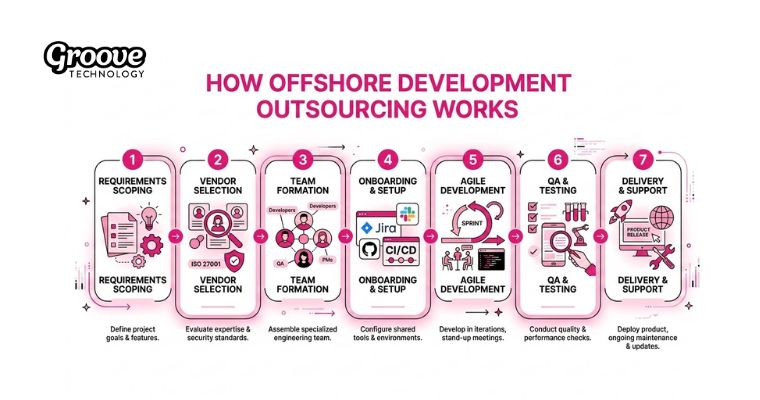
The offshore development process commonly follows these 7 steps:
1. Requirements Scoping: The client defines product goals, feature scope, and initial technical requirements. This documentation ensures both parties share a clear understanding of project expectations before development begins.
2. Vendor Selection: The client evaluates potential vendors based on technical expertise, project experience, and security standards. For example, companies such as Groove Technology hold ISO 27001 certification, demonstrating established information security management processes.
3. Team Formation: After the partnership agreement is signed, the vendor assembles a suitable engineering team, which may include developers, QA engineers, project managers, and scrum masters depending on project scope.
4. Onboarding and Tool Setup: Both sides configure the shared working environment, including access to Jira, Confluence, Slack, GitHub or GitLab, and CI/CD pipelines that automate build and deployment processes.
5. Sprint-Based Development: The offshore team develops the product in Agile sprints, typically lasting one to two weeks. Tasks are tracked in Jira, and progress is communicated through regular stand-up meetings.
6. QA and Testing: QA engineers conduct functional testing, integration testing, and performance testing to ensure the product meets quality standards before release.
7. Delivery and Post-Launch Support: After deployment, the offshore team continues to provide maintenance, bug fixes, and feature enhancements as required.
3. How Does Offshore Software Development Outsourcing Differ From Nearshore And Onshore Models?
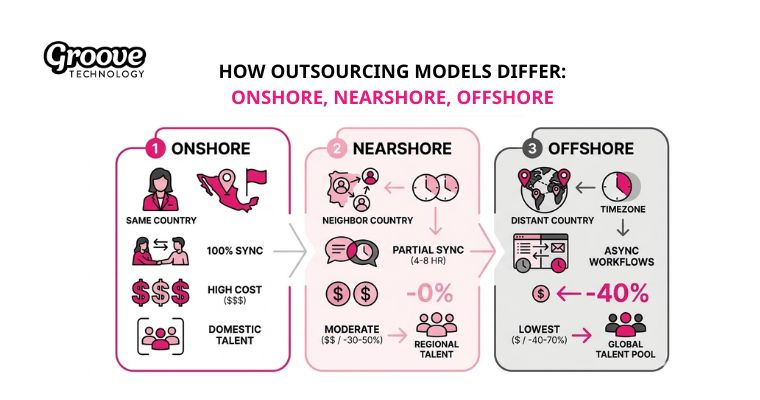
Onshore, nearshore, and offshore outsourcing differ across three main dimensions: geographic distance, cost structure, and real-time collaboration capacity. Among these models, offshore enables companies to maximize cost efficiency and access a global talent pool, onshore ensures seamless communication, while nearshore provides a balance between the two, typically at costs 30 – 50% lower than onshore.
- Onshore outsourcing refers to hiring a vendor located within the same country as the client. Both parties operate in the same timezone and legal environment, which enables fully synchronous collaboration and smooth communication. However, this model usually carries a cost premium of two to three times the offshore equivalent, and the available talent pool is limited to the domestic market.
- Nearshore outsourcing involves partnering with a vendor in a neighboring country, typically within one to three hours of the client’s timezone. As a result, both teams can maintain four to eight overlapping working hours per day, which is sufficient for daily standups and real-time decision-making. This model allows companies to reduce costs compared with onshore while maintaining effective collaboration. Common regional pairings include UK – Romania and US – Mexico.
- Offshore outsourcing refers to contracting a vendor in a distant country, usually four to twelve hours away from the client’s timezone. In this model, teams primarily collaborate through asynchronous workflows. In return, offshore provides the largest cost advantage (typically 40 – 70% lower than onshore) while also enabling access to a global talent pool.
You can compare the key features of each model in the table below to decide which structure fits your project needs best.
| Feature | Onshore | Nearshore | Offshore |
| Location | Same Country | Neighboring Country | Distant Country |
| Time Zone | Identical | Similar (+/- 1-3 hrs) | Significant (+/- 4-12 hrs) |
| Cost | High | Medium | Low |
| Communication | Seamless | Easy (High overlap) | Asynchronous (Low overlap) |
| Talent Pool | Limited (Local) | Regional | Massive (Global) |
| Ideal Use Case | Complex, IP-sensitive projects | Agile/Scrum teams needing overlap | MVPs, Maintenance, 24/7 Ops |
4. What Are The Benefits Of Outsourcing Software Development Offshore?
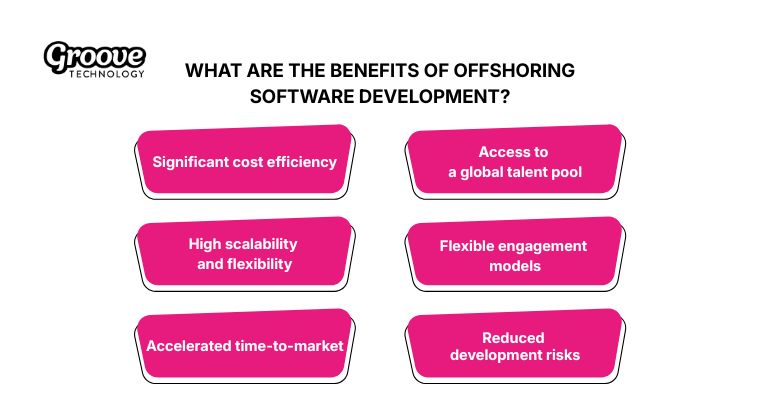
Offshoring software development provides several strategic advantages, including cost efficiency, scalable teams, faster time-to-market, access to global technical talent, flexible engagement models, and reduced delivery risk. When managed effectively, these 6 benefits extend beyond a single project and continue to create value across multiple product development cycles.
- Cost efficiency that supports business growth: Offshore development significantly reduces local hiring and operational costs such as employee benefits, office overhead, and lengthy recruitment processes. For example, the total employment cost of a senior software engineer in Australia typically ranges from AUD 130,000 to AUD 180,000 per year, while an engineer with comparable experience in Vietnam costs around AUD 30,000 to AUD 50,000 through an offshore partner. The cost difference allows organisations to expand engineering capacity, strengthen QA coverage, or invest more in product development.
- Scalability without operational complexity: Offshore outsourcing allows organisations to scale team size quickly based on project requirements without managing complex hiring or termination processes. A project may expand from three engineers during the MVP stage to fifteen engineers during full-scale development, and later reduce to two engineers during the maintenance phase. This flexibility eliminates the cost of maintaining idle engineers between development phases.
- Faster time-to-market: An experienced offshore partner can assemble a development team within two to four weeks, while recruiting equivalent local talent often requires three to six months. In addition, time-zone differences can support near-continuous development. For example, Vietnam operates roughly three hours behind Australia’s AEST, which enables daily overlap for coordination and allows development progress to continue after the local team ends its workday.
- Access to global, specialized talent: Offshoring removes geographic hiring constraints and enables organisations to access engineers with specialised expertise in areas such as AI, machine learning, cloud infrastructure, React Native, Node.js, IoT, and blockchain. This access becomes critical as many technology markets face talent shortages. In Australia alone, the ICT workforce gap exceeds 60,000 professionals, according to Cipher Projects (2025).
- Flexible engagement models: Offshore providers typically offer multiple engagement models, including dedicated teams, staff augmentation, and project-based development. Each model supports different project needs and timelines. For example, long-term product development often fits a dedicated team structure, while short feature sprints or clearly defined tasks may suit staff augmentation or project-based engagements.
- Reduced delivery and financial risk: Professional offshore vendors operate with structured project management, quality assurance processes, and automated testing frameworks such as Selenium, Postman, and Jest. They also provide transparent delivery dashboards and predictable monthly pricing models. These practices improve delivery reliability and reduce the risk of unexpected costs caused by post-deployment issues.
5. Which Countries Are The Best Offshore Software Development Destinations In 2026?
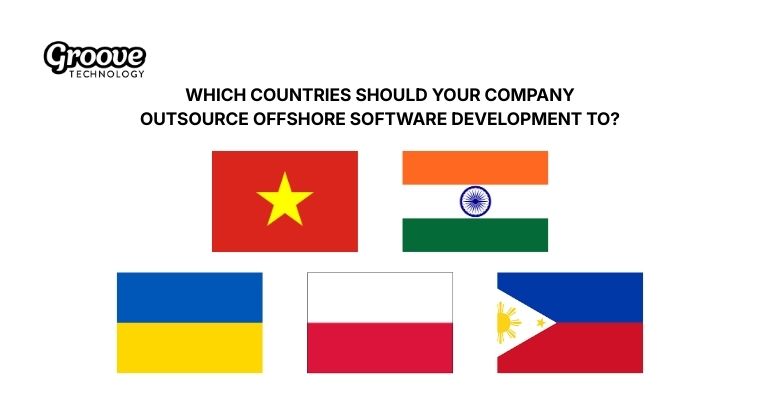
The most common offshore destinations today include Vietnam, India, Ukraine, Poland, and the Philippines. However, no single country dominates across all factors. The right choice typically depends on four key variables: hourly rates, talent pool size, timezone alignment, and technical specialisation.
For organisations in Australia and the broader APAC region, Southeast Asian destinations often offer advantages in cost efficiency and timezone compatibility, while Eastern European hubs are known for their strong engineering culture and stable legal environments. Ultimately, project quality depends more on vendor processes and management maturity than on geography alone.
- Vietnam: Vietnam produces around 57,000 IT graduates each year and offers development rates of approximately $20–$40 per hour. Its AEST +3 timezone enables convenient morning collaboration with Australian teams. Vietnam is particularly strong in fintech backend systems, ecommerce platforms, and agile product development.
- India: India has about 4.5 million technology professionals, making it the largest technical talent pool in the world. Development rates typically range from $25–$50 per hour, while the AEST +4.5 to +5.5 timezone difference often results in more asynchronous collaboration. India excels in enterprise software, AI/ML systems, and SAP/ERP implementations.
- Ukraine: Ukraine has more than 200,000 software engineers, with development rates of around $30–$60 per hour. The country operates in the CET +2 timezone (AEST –8), which limits working-hour overlap with APAC teams. Ukraine is particularly strong in blockchain development, .NET ecosystems, and cybersecurity.
- Poland: Poland is one of Europe’s leading technology hubs and operates under EU regulatory frameworks such as GDPR and intellectual property protections. Development rates typically range from $50–$100 per hour, and the country follows the CET +2 timezone (AEST –8). Poland is especially strong in cybersecurity, data analytics, and fintech solutions.
- Philippines: The Philippines offers development rates of around $20–$50 per hour and operates in the PHT timezone (AEST –2), which provides convenient overlap with Australian teams. The country is known for strong English proficiency and an internationally oriented work culture, and it performs particularly well in mobile apps, UX-focused web products, and customer-facing digital tools.
6. Which Offshore Software Development Engagement Model Fits Your Project?
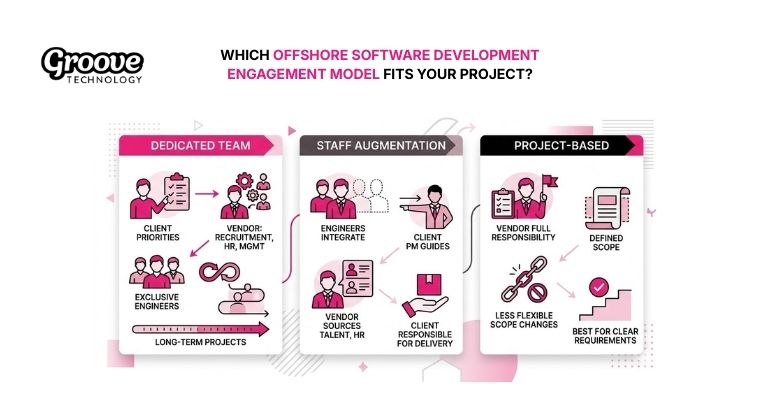
Offshore software development typically operates through three main engagement models: Dedicated Team, Staff Augmentation, and Project-Based. Each model suits different project durations, team structures, and levels of control.
- Dedicated Team: The client manages sprint priorities and product direction, while the vendor handles recruitment, HR, and team management. Engineers work exclusively on the client’s product, making this model suitable for long-term projects.
- Staff Augmentation: Offshore engineers integrate into the client’s existing team and work under the guidance of the internal project manager. The vendor focuses on talent sourcing and HR, while the client remains responsible for delivery.
- Project-Based: The vendor takes full responsibility for delivering a project with a defined scope. This model works best when requirements are clearly defined at the start, but it becomes less flexible if the scope changes during development.
| Model | Best For | Client Control | Cost Structure | Team Commitment | Typical Duration |
| Dedicated Team | Long-term products | High | Monthly retainer | Full-time | 6+ months |
| Staff Augmentation | Skill gaps | Highest | Hourly/monthly | Flexible | 1-12 months |
| Project-Based | Defined scope | Low | Fixed price | Project-bound | 3-6 months |
To choose the most suitable engagement model, companies should evaluate project duration, the likelihood of scope changes, and the structure of their existing engineering team. The following scenarios illustrate when each offshore model works best:
- Choose Dedicated Team if: The project is expected to last more than six months, and the product scope is likely to evolve throughout development. This model works best when the company wants direct control over sprint priorities, feature sequencing, and the overall product roadmap.
- Choose Staff Augmentation if: The company already has an internal engineering team but needs additional expertise to fill specific skill gaps. This model allows businesses to quickly integrate 1 – 5 engineers into their existing workflow and management structure.
- Choose Project-Based if: The scope, timeline, and deliverables are clearly defined before development begins. This model is most suitable for short-term projects (typically under three months) where the scope is unlikely to change during delivery.
7. How Much Does It Cost To Outsource Software Development Offshore?
The cost of offshore software development outsourcing typically ranges from $25 to $110 per hour, depending on the developer’s seniority, geographic location, and engagement model. In practice, most mid-market companies allocate a budget of approximately $15,000 to $80,000 per month for a dedicated development team of 4–8 engineers working full-time.
This cost range is primarily influenced by four key factors:
- Developer seniority: The rate difference between junior and senior developers typically ranges between 40 – 60%, as senior engineers bring deeper experience in system architecture, performance optimization, and complex technical problem-solving.
- Scarcity of specialised technology stacks: Technologies with limited talent supply, such as AI/ML, blockchain, data engineering, or advanced DevOps which often command higher rates compared with more common development stacks.
- Engagement model: A dedicated team model usually provides predictable monthly costs and stable capacity. In contrast, staff augmentation offers greater flexibility, but total costs may vary depending on the number of engineers added during different project phases.
- Project complexity: Projects that require complex system integrations, microservices architecture, or AI-powered features typically involve a broader scope of work and therefore result in higher overall development costs.
The following rate benchmarks reflect 2025 market data:
Region | Junior Dev ($/hr) | Mid-Level Dev ($/hr) | Senior Dev ($/hr) | Engagement Model Fit |
| Australia / UK (onshore) | $120–$180 | $150–$220 | $180–$280 | Onshore hire, highest cost |
Eastern Europe | $40–$65 | $55–$85 | $70–$110 | Nearshore for European clients |
| India | $20–$40 | $30–$55 | $45–$75 | Offshore, high volume, varied quality |
Vietnam | $25–$45 | $35–$60 | $50–$80 | Offshore, strong QA culture, ISO 27001 common |
| Latin America | $35–$55 | $45–$70 | $60–$95 | Nearshore for US/Canada clients |
The rate benchmarks shown in the table above reflect 2025 market data. Among major offshore hubs in Asia, Vietnam offers a strong cost-to-quality ratio, supported by a large pool of experienced software engineers and competitive operational costs. In addition, companies such as Groove Technology apply transparent pricing models in which all costs are finalized before the project begins, ensuring that no hidden fees appear during delivery.
Note: To build an effective outsourcing budget, companies should first define the project scope and required team size. After that, they can request a fixed cost breakdown that details pricing for each role and development phase.
8. What Should You Look for When Hiring an Offshore Software Development Partner?
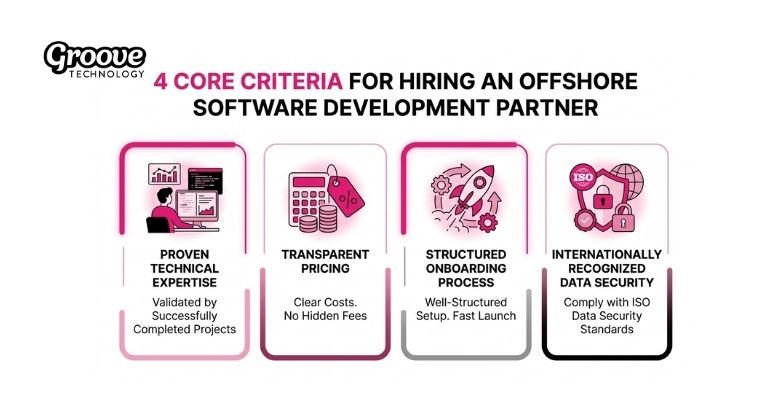
A reliable offshore software development partner should meet four core criteria: proven technical expertise, transparent pricing, a structured onboarding process, and internationally recognized data security standards.
- First, the provider must demonstrate technical expertise validated by successfully completed projects.
- Second, the company should offer transparent pricing with no hidden fees.
- Third, the onboarding process should be well-structured and capable of launching quickly.
- Finally, the partner should comply with international data security standards such as ISO certifications to ensure the protection of client systems and information.
To evaluate and select the right partner, companies can follow 8 steps:
1. Review the completed project portfolio: Companies should evaluate the vendor’s previous projects, particularly those that demonstrate domain relevance or similar business models.
2. Verify technical and security certifications: Certifications such as ISO 27001 or CMMI indicate that the vendor maintains internationally recognized standards for quality management and information security.
3. Check the client retention rate: A client retention rate of 90% or higher often reflects strong service stability and high customer satisfaction.
4. Assess onboarding speed: Reputable outsourcing partners can typically form and deploy a development team within 2–4 weeks after the project requirements are finalized.
5. Evaluate communication responsiveness: Companies should observe the vendor’s responsiveness during early discussions, as professional partners usually respond within four business hours.
6. Request a transparent cost breakdown: Before signing a contract, companies should request a detailed cost breakdown that clearly outlines pricing for each role and project phase.
7. Review intellectual property (IP) ownership clauses: The contract should clearly define ownership of source code, data, and final deliverables, ensuring that the client retains full control of the product.
8. Confirm experience with your technology stack: Companies should ensure that the partner has proven experience with the specific technologies, frameworks, or platforms required for the project.
9. What Are the Common Risks of Offshore Software Development Outsourcing and How Do You Mitigate Them?
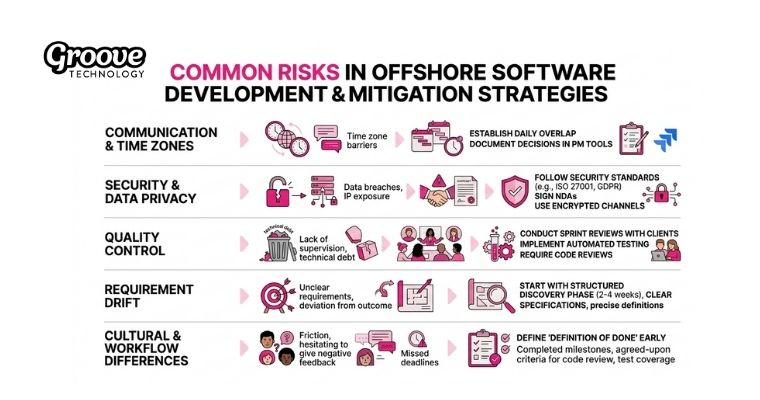
Offshoring software development offers many advantages, but this model also introduces several common challenges. These challenges typically include communication and time zone barriers, data security risks, quality inconsistency due to limited oversight, requirement drift or scope misalignment, and cultural or workflow differences. However, these 5 issues are predictable, and organizations can effectively manage them by implementing clear processes and structured collaboration frameworks.
1. Communication and time zone barriers: Time zone differences often slow down communication and decision-making. A simple clarification that takes only a few minutes in a co-located office may take up to 24 hours when working with an offshore team. To reduce delays, companies should establish at least two hours of mandatory daily overlap and document all key decisions in project management tools such as Jira to ensure transparency during asynchronous work.
2. Security and data privacy risks: Cross-border collaboration requires sharing source code, system access, and sensitive business data, which increases the risk of data breaches or intellectual property exposure without proper controls. Therefore, companies should require partners to follow security standards such as ISO 27001, comply with frameworks like GDPR, use encrypted communication channels, and sign NDAs before granting repository or system access.
3. Quality control and technical oversight: The lack of direct supervision can allow technical issues or technical debt to accumulate across multiple sprints, which often surface later during scaling or maintenance phases, when fixing them becomes significantly more expensive. To maintain consistent quality, companies should conduct sprint reviews with client participation, implement automated testing pipelines, and require mandatory code reviews before every merge to the main branch.
4. Requirement Drift and Scope Misalignment: Offshore teams typically build exactly what the specifications describe. If initial requirements are unclear or inaccurate, the final product may deviate from the intended outcome. Each change request also adds communication cycles that increase time and cost, which is why many companies start with a structured discovery phase lasting two to four weeks.
5. Cultural and workflow differences: Differences in communication styles, public holidays, and expectations around project completion can create collaboration friction. Some teams may communicate indirectly or hesitate to give negative feedback, delaying issue detection. To prevent misunderstandings, organizations should clearly define the “definition of done” early in the project, including criteria for code review, test coverage, and technical documentation.
10. Frequently Asked Questions
Is offshore software development outsourcing right for small businesses?
Yes. Offshore software development outsourcing can be a practical option for small businesses because it reduces hiring costs while providing access to experienced global developers. This model allows smaller companies to build or scale digital products without maintaining a full in-house engineering team.
How long does it take to start an offshore software development project?
Most offshore projects begin within 2 – 4 weeks after the requirements are finalized and the vendor is selected. During this period, the partner assembles the development team, completes onboarding, and sets up the necessary tools and workflows.
When should a company start outsourcing software development offshore?
A company should consider offshore outsourcing when it needs to scale development capacity quickly, access specialized technical expertise, or reduce operational costs while continuing to focus on core business activities.
This guide defined offshore software development outsourcing, explored essential benefits like cost efficiency, and compared leading global destinations to clarify your options. You now possess the insights needed to assess the market and select a partner that drives real operational growth.
Groove Technology helps you achieve this technical excellence through our Australian-managed, Vietnam-based engineering teams. We build custom solutions that align strictly with your business objectives while maintaining transparency and innovation. You can contact us today to secure a high-performance team for your next project.
References:
1. Australia Offshore Software Development: Your 2025 Success Blueprint
https://cipherprojects.com/blog/posts/australia-offshore-software-development-2025-success-blueprint/

