


Software Development Outsourcing: The Complete Guide 2026
Software development outsourcing involves contracting external vendors to manage and execute your software projects. This approach significantly optimizes financial performance, with Deloitte reporting operational cost reductions of up to 60%, driving a global market projected to reach $940 billion by 2034 at a 5.8% CAGR (Market.us).
The industry is structured into 5 distinct geographic and integration formats: onshore, nearshore, offshore, onsite, and rightshoring, which are executed through 4 primary engagement models: staff augmentation, dedicated teams, project-based contracts, and managed services. Financial feasibility remains a core driver, as global hourly rates fluctuate between $18 and $85 based on regional economics, developer seniority, and the complexity of the tech stack.
As of 2026, the premier destinations for this talent include high-growth hubs such as India, Vietnam, China, and the Philippines in Asia; Poland, Ukraine, and Romania in Eastern Europe; and Mexico, Brazil, and Argentina in Latin America
This comprehensive guide covers outsourcing models, core benefits, potential challenges, and practical steps for success. It helps you choose the right partner and scale effectively while minimizing risks. Please read the detailed sections below to start your next software project.
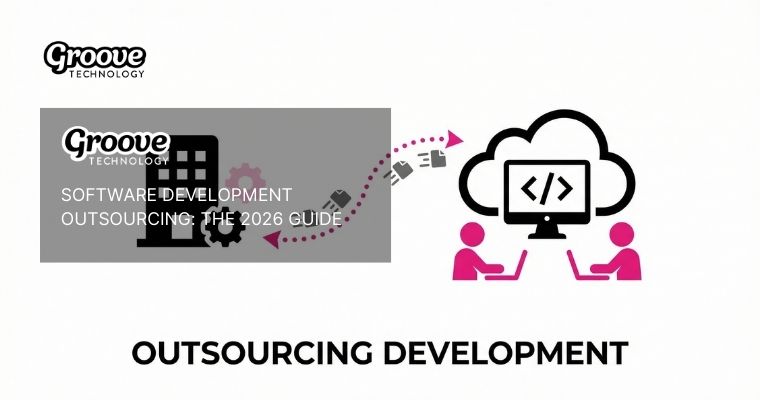
What is software development outsourcing?
Software development outsourcing is the practice of contracting external vendors to manage and execute your software projects. This means that instead of relying on your own staff, you are contracting third-party vendors to execute software projects that would otherwise be managed in-house.
Software development outsourcing services cover many aspects of software development. This includes building custom software, creating mobile and web apps, testing for quality, keeping systems running, and giving expert advice.
This approach offers six major benefits, starting with big cost savings on hiring, training, and office equipment. It gives you access to skilled experts from around the world, helping address local talent shortages. External teams often work efficiently to help you launch products faster, allowing your internal team to focus on core business growth. It is also flexible, allowing you to easily adjust the team size as needed, while specialized partners help reduce project risks.
While this is a useful solution, it comes with specific requirements for success. You must watch out for challenges such as communication gaps, quality issues, and data security risks. Overall, this is a popular choice for both startups building from scratch and established companies looking to grow, as the global software development outsourcing market is expected to reach USD 940.0 billion by 2034, growing at a CAGR of 5.8% from 2025 to 2034, according to Market.us.
So how does software development outsourcing differ from hiring freelancers and general IT outsourcing, and why is it often the superior choice? While outsourcing involves structured teams with dedicated members, freelancing relies on individual contributors with a limited accountability structure and no organizational backup when issues arise. A freelancer can disappear mid-project. In contrast, the distinct advantage of an outsourcing partner is that they have obligations, backup engineers, and a reputation to protect.
How does this differ from general IT outsourcing, too? While general IT outsourcing, which often includes some or all of an organization’s IT functions, focuses on the entire IT function, outsourced software development focuses solely on software or application projects. The major pro of software outsourcing here is highly targeted expertise: rather than providing broad IT maintenance, an outsourced software team brings specialized, dedicated engineering skills tailored to building your product.
Understanding what this practice entails is just the foundation of a successful strategy. The next step is determining the specific scenarios in which external help will provide the most value to your business.

When should you outsource software development services?
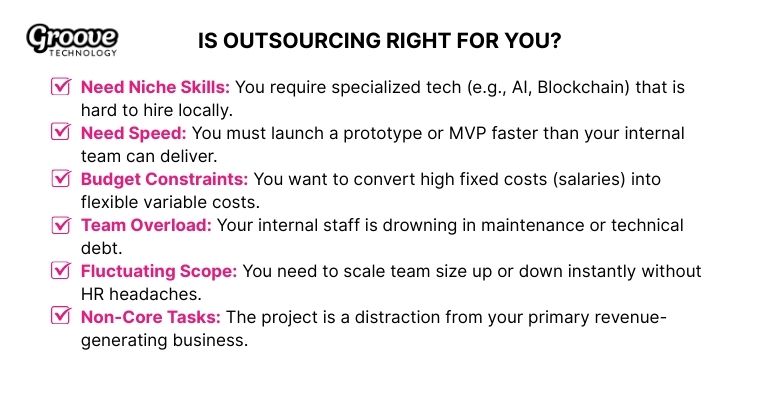
Outsourcing software development is ideal when internal constraints, such as talent gaps, tight budgets, or aggressive deadlines, hinder your ability to scale, innovate, or focus on core business objectives. To navigate these hurdles and regain strategic momentum, you should evaluate your current operational health. If you find your business struggling with any of the following 6 scenarios below, transitioning to an outsourcing model may be the most efficient path forward. Here are the six scenarios
- When You Need Specialized Talent: Specialized talent refers to individuals possessing unique, niche, or highly advanced skills required for specific, often hard-to-fill, roles. You hire external experts if your project requires capabilities in niche technologies such as AI or blockchain that your current team lacks, thereby bypassing the long recruitment process. Nowadays, 42% of leaders cite access to talent as a top reason for outsourcing, according to Skray’s report.
- When Fast Time-to-Market is Priority: Time-to-market is the total duration from a product’s initial conception and research through development to its final launch. You engage external partners when you need to build a prototype or MVP faster than your internal team can manage, effectively shortening the cycle from idea to public release. Outsourcing helps shorten the time-to-market, according to Deloitte.
- When Budget Constraints Limit Operations: Budgetary constraints are limitations on how much money a business can spend, representing the maximum level of service that can be afforded within a given income. You choose this route when you need to avoid the high costs of hiring full-time employees, thereby converting fixed overhead into variable costs by leveraging global talent. Outsourcing can reduce operational costs by up to 60%, according to Deloitte.
- When Your Internal Team is Overwhelmed: An internal team is overwhelmed when members are burdened by excessive workloads or unrealistic deadlines, leaving them feeling unable to meet demands. You bring in outside help when your developers are drowning in technical debt or maintenance, allowing them to recover while the vendor handles specific workstreams.
- When You Need to Scale Up or Down Quickly: Project scaling is the deliberate process of expanding a project’s impact or scope while maintaining quality. You use outsourcing when projects are temporary or fluctuate in scope, as it allows you to adjust team size instantly without the inefficiency of hiring or firing permanent staff.
- When The Project is a Non-Core Product: A non-core project is a peripheral activity that does not directly contribute to a company’s primary business goals or revenue generation. You transfer these distractions to a vendor so you can focus your internal resources on primary functions, such as sales, while the partner keeps secondary systems running.
Here are the checklist in summary to check whether your business needs software development outsourcing:
While these six scenarios highlight the immense benefits of external partnerships, outsourcing is not a universal remedy for every technical challenge. Recognizing situations where internal control is mandatory is equally important to safeguard your company.
So, when should you NOT outsource software development services?
You should avoid outsourcing and keep projects in-house when dealing with highly sensitive intellectual property or trade secrets that must remain strictly confidential to protect your competitive edge. Additionally, if your project requirements are vague, fluid, or lack a clear roadmap, external vendors will struggle to define costs or deliver effectively.
Finally, outsourcing is risky if you lack internal technical leadership to review code quality and manage the vendor’s deliverables. Knowing when to maintain internal control ensures your core assets remain protected from unnecessary risks. Once you confirm your project is suitable for external collaboration, you must select the appropriate geographical and logistical approach.
5 Common Types of Software Development Outsourcing
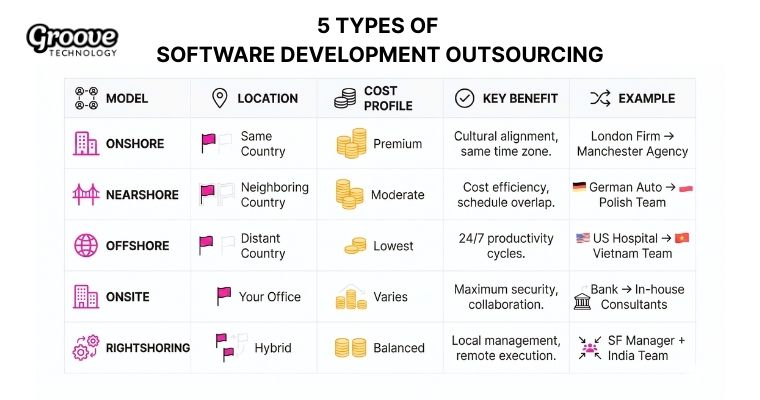
Software development outsourcing is primarily categorized into five types, including onshore, nearshore, offshore, onsite, and rightshoring, based on geographic proximity and team integration. Because each model offers a unique balance of cost-efficiency, cultural alignment, and delivery speed, selecting the right one is critical to project success. To help you make an informed decision, the following table compares how each type aligns with your budget and operational goals.
Types of Outsourcing | Simple Definition & Benefit | Shortened Example |
Onshore | Hiring a partner in your own country. You get the same culture and time zone, but costs are higher. | A London startup is hiring a local agency in Manchester. |
Nearshore | Hiring a partner in a nearby country. You save money while keeping a similar time zone for easy communication. | A German car maker is working with a team in Poland. |
Offshore | Hiring a partner in a faraway country. This provides the lowest cost and enables work to run 24/7. | A US healthcare firm is using a team in Vietnam. |
| Onsite Outsourcing | Bringing outside experts into your actual office. Best for security and working closely together. | A bank is bringing in security experts to its trading floor. |
Rightshoring and Hybrid Models | Mixing local managers with remote teams. This balances low costs with local control. | A San Francisco manager leading a remote team in India. |
Selecting the right geographic model dictates your team’s physical location and daily collaboration rhythms. After deciding where your external team will be based, you must determine how they will integrate with your existing workforce.
What are the common engagement models for software outsourcing?
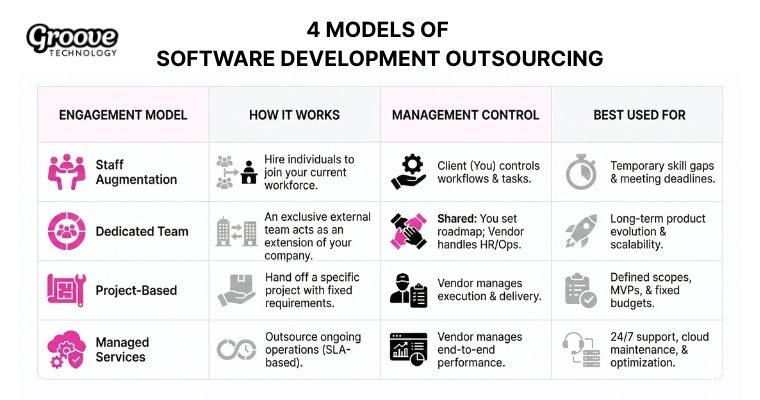
Software development outsourcing operates through four primary engagement models, including staff augmentation, dedicated teams, project-based contracts, and managed services. Since each model is designed to address specific project scopes, budget structures, and levels of managerial control, your choice should depend on your internal capacity and long-term goals. To help you identify the most effective partnership for your business, the table below provides a detailed breakdown of these differences
Model | Best For | Client Control | Cost Structure | Team Commitment | Typical Duration |
Dedicated Team | Long-term products | High | Monthly retainer | Full-time | 6+ months |
Staff Augmentation | Skill gaps | Highest | Hourly/monthly | Flexible | 1-12 months |
Project-Based | Defined scope | Low | Fixed price | Project-bound | 3-6 months |
| Managed Services | Ongoing operations | Lowest | SLA-based | Shared | 12+ months |
Groove Technology focuses on three primary models: Dedicated Teams, Staff Augmentation, and Project-Based contracts. We prioritize these frameworks because they give clients the most direct control over development quality and seamless team integration. Selecting the ideal model typically depends on your organization’s current stage. For instance, startups often utilize Project-Based work to manage initial costs, whereas enterprises frequently prefer Dedicated Teams for long-term stability.
It is also common to transition between models as your needs evolve. Many partners begin with Staff Augmentation to resolve immediate technical gaps before moving to a Dedicated Team as their workload grows and stabilizes. Ultimately, structuring your engagement correctly ensures that communication and budgeting remain aligned with your specific project scope. With this operational framework in place, your organization can fully realize the strategic advantages of software outsourcing
Why should companies outsource software development?
Companies should outsource software development to reduce development costs, access a global talent pool, accelerate time-to-market, enhance team scalability, enable focus on core business, and distribute project risk. These six benefits drive efficiency and strategic growth as outlined in the following key points:
1. Reduces development costs: Cost reduction stands as the primary driver. Organizations convert fixed development overhead into variable expenses by working with teams in competitive-rate regions across Asia, Eastern Europe, and Latin America.
2. Accesses a global talent pool: Global talent access solves domestic hiring gaps. Companies recruit engineers based on skill match rather than geographic proximity, gaining specialized capabilities that may not exist in their local market.
3. Accelerates time-to-market: Faster time-to-market results from parallel development workflows. Teams operating across time zones maintain continuous progress, compressing launch timelines by months.
4. Enhances team scalability and flexibility: Scalable team structures allow organizations to adjust engineering capacity within weeks rather than months. This on-demand model eliminates the fixed cost burden of maintaining permanent staff for fluctuating workloads.
5. Enables focus on core business and strategic growth: Sharper strategic focus follows when leadership delegates technical execution. Revenue-generating activities such as sales, marketing, and product development reclaim time previously spent on IT operations management.
6. Distributes risk and shares accountability: Distributed risk protects against single points of failure. Outsourcing partners maintain backup talent pools and are contractually accountable for meeting delivery milestones and security standards.
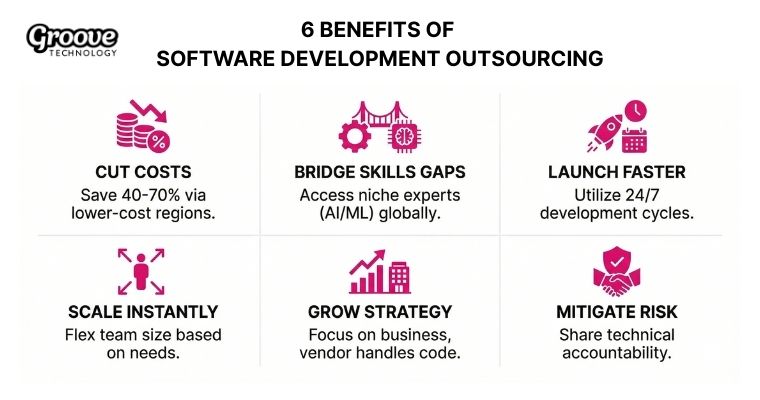
Each of the six advantages above has specific implementation patterns, as explored in our detailed analysis of the 6 Key Benefits of Outsourcing Software Development: Cost, Talent, Speed, and Strategic Growth.
These compelling benefits can transform an organization’s efficiency, but they do not materialize automatically. Securing these advantages requires a disciplined, step-by-step approach to finding and managing the right partner.
How can businesses effectively outsource software development
To outsource software development effectively, businesses should follow a 7-step strategic roadmap to mitigate risk and ensure project alignment. This process begins with clarifying goals and choosing the right engagement model, followed by screening vendors and finalizing contracts. Once the partnership is formalized, the focus shifts to onboarding the team, executing development sprints, and conducting a comprehensive final handover. By following these essential steps, you can establish a high-ROI partnership that delivers consistent value from start to finish.
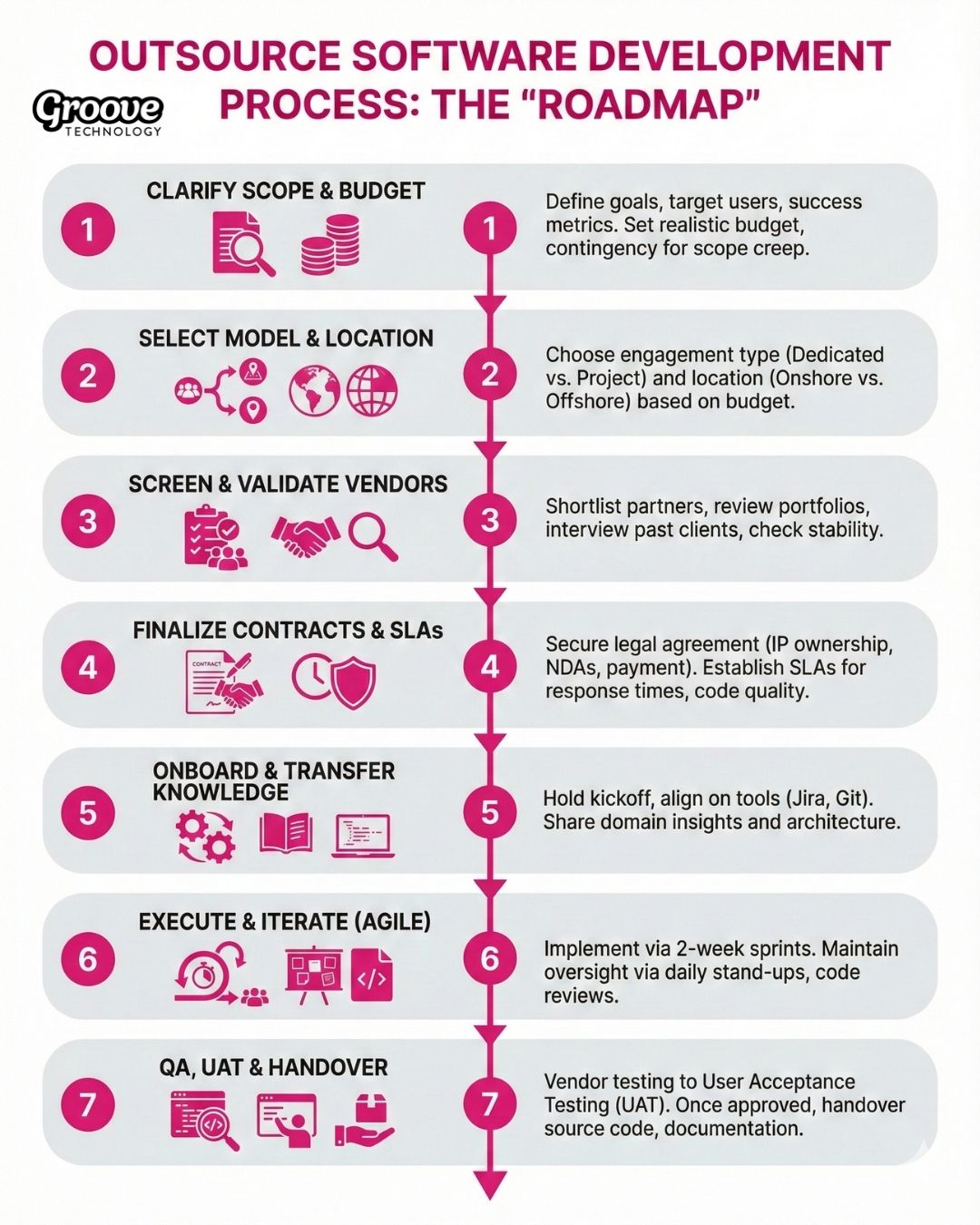
Step 1: Clarify goals, scope, and budget
You need to start by clearly defining what you want to build, who will use it, and how much money you can spend. Before you hire anyone, list your main business goals and how you will measure success. You should list the core features you need, along with requirements such as speed and security. It is also important to set a realistic budget range. We recommend keeping an extra 15–20% of your money as a safety fund. This helps you handle unexpected changes without slowing down the project.
Step 2: Determine engagement model and location
Once you have identified your needs, the next step is to align your project type with the most suitable engagement model and geographic region. This selection should be guided by three critical factors: your internal management capacity, the projected project duration, and the expected frequency of requirement changes. For instance, short-term builds with a fixed scope are best suited for project-based outsourcing, whereas long-term products with evolving features require the stability of a dedicated team.
Furthermore, when selecting a location, it is essential to balance your budget against the daily communication overlap your workflow requires. Success often hinges on real-time collaboration; teams with fewer than three hours of shared working time frequently encounter communication delays that can significantly hinder sprint velocity
Step 3: Screen vendors and validate fit
This stage involves filtering potential partners based on technical proficiency, industry track record, and team stability. You should begin by shortlisting firms with proven expertise in your specific tech stack and industry domain, and then verify their delivery accuracy and cultural alignment through third-party platforms like Clutch, G2, or Google Business. These reviews offer critical insights into a vendor’s responsiveness and overall reliability.
Following the initial screening, it is vital to assess the vendor’s internal stability by examining their team size, seniority mix, and developer retention rates. A vendor maintaining an annual retention rate above 85% is a strong indicator of operational maturity and the ability to provide consistent, long-term project support
Step 4: Finalize contracts and SLAs
Once a partner is selected, the focus shifts to finalizing contracts, agreeing on payment terms, and establishing measurable performance standards. A Service Level Agreement (SLA) serves as the cornerstone of this process, formally defining service quality and vendor accountability. To ensure a secure partnership, your contract must clearly specify intellectual property (IP) ownership, payment milestones, and Non-Disclosure Agreements (NDAs).
Furthermore, it is essential to embed specific benchmarks into your SLAs, such as a 24-hour code-review turnaround and a 4-hour bug-fix response, with defined penalties for missed targets. This structured approach protects your financial interests and project timeline through enforceable accountability, ensuring that both parties remain aligned on delivery expectations
Step 5: Onboard and Transfer Knowledge
This phase focuses on the onboarding and knowledge transfer to ensure the new team fully aligns with your business objectives. Start with a kickoff meeting to standardize communication channels and project management tools. From there, conduct a technical deep dive into your existing systems and software release workflows. Once the team masters your internal setup, they can execute tasks autonomously, reducing the need for constant supervision while maintaining high delivery standards
Step 6: Execute, Monitor, and Iterate
This phase focuses on executing Agile two-week sprints, which are fixed 10-day iterations where teams plan, build, and test functional product increments. This time-boxed approach ensures continuous delivery while allowing for regular feedback and rapid adjustments. To maintain project momentum, implement structured monitoring through daily stand-ups and rigorous code reviews to track progress against your roadmap.
By evaluating results in real time, you can identify bugs early and pivot quickly as requirements evolve. This iterative cycle ensures that the development process remains strictly aligned with your business goals through constant optimization and performance tracking
Step 7: Assure Quality, UAT, and Handover
Before the final launch, the process transitions from vendor testing to User Acceptance Testing (UAT). This critical phase allows your team to evaluate the software against real-world business scenarios rather than just technical specifications. Through systematic Quality Assurance, UAT confirms that the product meets all established quality standards. Once these tests are passed, a formal handover is executed to transfer all source code, API credentials, and technical documentation.
This comprehensive transfer ensures you maintain full legal ownership and operational control of your product. Following this structured methodology guarantees a smooth transition and protects your investment from inception to completion. However, a critical part of planning this process is understanding the financial commitments involved.
How much does software development outsourcing cost?
Global software development outsourcing rates typically range from $18 to $85 per hour, with final costs depending on geography, role seniority, and the project’s specific tech stack. While South and Southeast Asia offer the most competitive entry-level pricing, Latin America is highly valued for its overlapping time zones with North American markets. For complex projects involving AI, cloud infrastructure, or regulated domains such as healthcare and finance, Central and Eastern Europe often provides the optimal balance between cost and high-end technical quality.
Ultimately, your total investment will vary significantly depending on your chosen region and the project’s overall complexity. To help you plan your budget effectively, the table below provides a detailed comparison of hourly rates across these key global outsourcing hubs:
Role | Central/Eastern Europe | Latin America | South & Southeast Asia | Avg monthly cost (CEE) |
Business Analyst | $50–$63/h | $45–$55/h | $30–$42/h | ~$8,960 |
Solution Architect | $50–$77/h | $60–$72/h | $35–$48/h | ~$10,200 |
UI/UX Designer | $56–$76/h | $40–$50/h | $25–$36/h | ~$10,560 |
Frontend/Backend Developer | $55–$70/h | $35–$61/h | $18–$42/h | ~$10,000 |
QA Engineer | $45–$63/h | $30–$50/h | $15–$36/h | ~$8,640 |
Project Manager | $45–$70/h | $55–$66/h | $35–$48/h | ~$9,200 |
DevOps Engineer | $60–$85/h | $40–$60/h | $22–$40/h | ~$11,600 |
(Source: CleverRoad)
While establishing a budget is essential for planning, financial considerations are just one part of the broader project equation. Managing external teams also introduces specific operational hurdles that must be proactively mitigated.
What are the primary risks associated with outsourcing software projects?
The primary risks associated with outsourcing software projects include significant time zone disparities, communication barriers, and inconsistent quality control. Furthermore, businesses often face critical security vulnerabilities and hidden costs, both of which must be proactively managed to ensure a successful partnership. These obstacles can hinder project progress if a clear risk mitigation strategy is not established from the outset.
A detailed explanation of how to address each of these five critical challenges is provided below:
1. Time zone differences: Disparities in local time across regions can delay responses because one team is asleep while the other is working. You can solve this by scheduling specific “overlap hours” for real-time meetings. Tools like Jira enable your teams to leave clear instructions without requiring immediate replies.
2. Communication Barriers: Language differences and physical distance are the two main factors that lead to misunderstandings and derail projects. To overcome this, select partners with strong English skills. Daily video calls and shared documentation can also help ensure everyone remains aligned on objectives.
3. Quality Control: External teams might produce messy code that requires extensive rework later. This can be prevented by establishing clear coding standards upfront. Regular code reviews and automated testing tools guarantee the output meets your technical expectations at every stage.
4. Security Concerns: When outsourcing, sharing proprietary code with third parties is necessary, which increases the risk of theft. You can mitigate this by enforcing strict Non-Disclosure Agreements (NDAs), verifying their security protocols, and using password-protected channels to transfer sensitive files safely.
5. Hidden Costs: Expenses that are not immediately apparent in the initial budget often arise from vague planning and will force you to pay for unexpected extra work. To avoid this, you can request or choose detailed contracts that specify exactly what is included. Agreeing on fixed prices or clear hourly rates helps keep your spending predictable and within budget
Fortunately, these risks are entirely manageable through strategic scheduling and standardized communication protocols. By enforcing rigorous quality benchmarks, robust security agreements, and transparent contracting, your organization can effectively neutralize these threats and maintain a high-performing development environment.
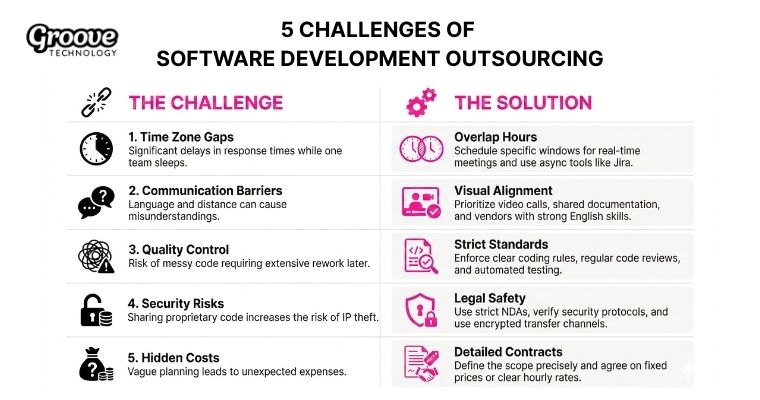
Overcoming these common obstacles requires foresight and the implementation of robust communication strategies. Ultimately, the easiest way to avoid these pitfalls is to meticulously evaluate and select an exceptional vendor.
How to choose the right outsourcing partner?
Selecting the right outsourcing partner requires a comprehensive evaluation of technical expertise, communication protocols, security compliance, and cultural alignment. To ensure long-term project success, businesses should also prioritize scalability and proven development methodologies that deliver consistent value. By focusing on these core competencies, you can identify a partner that not only meets your technical requirements but also integrates seamlessly with your internal team.
To find the ideal match for your organization, evaluate the following 7 critical factors:
- Technical Expertise and Portfolio: Technical expertise refers to the specialized, practical knowledge required to perform specific tasks. You must review their past projects and case studies to verify they possess the specific skills necessary to execute your unique project requirements without failure. Also, don’t forget to check for clients’ feedback on Clutch or G2 to get a real sense of the collaboration experience.
- Communication and Transparency: Transparency is the open sharing of real-time project goals, risks, and budget with everyone. You need to assess their responsiveness and language proficiency early on to ensure they provide regular updates and maintain full project visibility throughout the engagement lifecycle.
- Security and Compliance: Security involves implementing technical controls to defend against cyber threats, whereas compliance refers to adhering to external regulatory, legal, and industry standards. You should confirm that the partner has robust data protection and intellectual property measures that strictly comply with critical regulations such as GDPR and ISO 27001.
- Cultural Fit and Working Style: Cultural fit refers to how well a candidate’s values align with an organization’s principles and working style. You must evaluate whether your organization’s values and communication patterns align with those of their company to ensure smooth, conflict-free collaboration across all levels of the partnership.
- Scalability and Flexibility: Scalability is the capacity to handle increased workload by adding resources, while flexibility is the capability to adapt to changing business requirements without costly overhauls. You verify that the partner can rapidly scale the team up or down to meet your project’s changing needs and maintain operational efficiency during peak periods.
- Cost and Value: You should focus on the long-term return on investment (ROI), ensuring you pay for reliable outcomes rather than just hours worked. Cheap bids often lead to expensive mistakes, rework, and delays. True value balances your budget with the expertise needed for success.
- Methodology and Process: Methodology is the strategic framework that guides a project’s “why” and “how,” while a process is the specific, repeatable series of steps used to achieve the “what.” You have to verify they use Agile or other suitable development methodologies to guarantee high-quality, iterative delivery that consistently meets your deadlines and performance expectations.
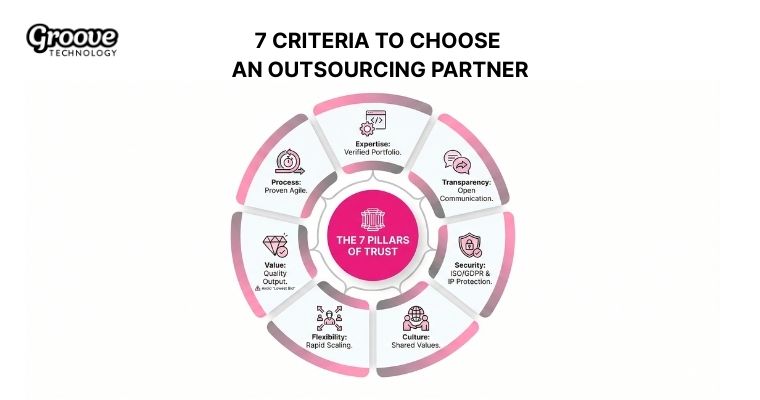
Thorough vetting of potential partners ensures their technical capabilities and business practices align perfectly with your needs. Once you know what qualities to look for, exploring the world’s most prominent technology hubs will help narrow down your search.
Top 10 regions for software development outsourcing in 2026
In 2026, the top 10 regions for software development outsourcing are India, Vietnam, China, the Philippines, Poland, Ukraine, Romania, Mexico, Brazil, and Argentina. These hubs offer a strategic blend of cost-efficiency, technical expertise, and diverse talent pools.
We have summarized the developer pool, average rate, timezone, English proficiency, and top specializations for these 10 countries in the table below:
| Country | Developer Pool (Est.) | Avg Rate ($/hr) | Timezone (vs GMT) | English Proficiency | Top Specialisations |
| India | ~5.8M – 6M | $20 – $50 | GMT+5:30 | Moderate (High in IT) | AI/ML, BFSI, Enterprise Software, Cloud Computing |
| Vietnam | ~530,000+ | $20 – $50 | GMT+7 | Moderate | Web/Mobile App, QA Automation, AI/ML (Emerging), Embedded |
| China | ~7.0M+ | $25 – $45 | GMT+8 | Low (Moderate in IT) | Functional Programming, AI, Big Data, Python |
| Philippines | ~190,000+ | $25 – $45 | GMT+8 | High (Official Language) | BPO-linked Tech Support, Front-end, Mobile Dev |
| Poland | ~500,000+ | $40 – $65 | GMT+1 | Very High | Fintech, Cybersecurity, Cloud, Enterprise Java/.NET |
| Ukraine | ~250,000 | $30 – $60 | GMT+2 | Moderate/High | High-complexity Engineering, AI, Security, Blockchain |
| Romania | ~200,000 | $35 – $55 | GMT+2 | High | Fintech, Embedded Systems, R&D, Cybersecurity |
| Mexico | ~800,000 | $35 – $65 | GMT-6 | Low (Moderate in IT) | Fintech, Healthcare, Nearshore Agile Teams (US aligned) |
| Brazil | ~630,000 | $30 – $60 | GMT-3 | Low (Moderate in IT) | Mobile Dev, Enterprise Software, Java/Python, Agile |
| Argentina | ~150,000 | $35 – $60 | GMT-3 | High (Best in LATAM) | Data Science, Creative Tech/UX, Mobile Dev |
Exploring these global regions provides a wealth of options, allowing you to balance cost with specialized expertise. If you are specifically looking toward Southeast Asia, learning about established providers in that area can accelerate your project launch.
How Groove Technology delivers software development outsourcing
Groove Technology is an Australian software outsourcing company established in 2016 that connects you with high-performance development teams based in Vietnam. We build custom software solutions for clients across Australia, Asia, and Europe, strictly prioritizing transparency and long-term growth to align with your business objectives.
You will secure three specific operational advantages when choosing us as your technical partner.
- Easy On-boarding: Your current workflows integrate naturally with our flexible processes, regardless of whether you use Agile, Scrum, or Kanban. Our engineers actively listen and clarify requirements to close any gaps between your expectations and the final results.
- Transparent Cost Management: Your budget stays clear through precise cost breakdowns and defined performance incentives, eliminating financial surprises. We finalize all expenses upfront while keeping the flexibility to adjust your spending dynamically as your project scales.
- Quality Assurance: Our certified developers pass rigorous recruitment tests to guarantee high technical proficiency and professional attitudes. We maintain this standard through continuous training programs that keep your dedicated team effective throughout the entire partnership lifecycle.

Partnering with a proven vendor streamlines the complex process of building a dedicated offshore engineering team. To fully leverage their capabilities, you must ensure their technical toolkit matches the specific requirements of your product architecture.
Tech stack for software development outsourcing
We provide thirteen essential technology categories to build a robust software ecosystem, covering everything from backend logic and frontend interfaces to advanced AI integration and security protocols:
Category | Technologies |
| Back End | .NET, Python, Node.js |
| Front End | HTML5, CSS3, JavaScript (JS), Angular, React.js, Meteor, Vue.js, Ember.js |
| AI & LLM | OpenAI, Claude, Gemini, Grok, Deepseek, LangChain, TensorFlow |
| Automation | n8n, Dify, Azure AI Studio, Power Automate |
| Mobile | Android, Flutter, iOS, PWA (Progressive Web App), React Native, Xamarin |
| Clouds | AWS, Azure, Digital Ocean, Google Developer Tools, Rackspace |
| Relational Databases | Amazon RDS, Azure SQL Database, Google Cloud SQL, MySQL, Oracle, PostgreSQL, SQL Server |
| Big Data / NoSQL | Amazon DocumentDB, Amazon DynamoDB, Apache Cassandra, Amazon Redshift, Apache Hive, Apache Kafka, Apache Spark, Apache Zookeeper, AWS Elasticache, Azure Blob Storage, Azure Cosmos DB, Azure Data Lake, Google Cloud Datastore, Hadoop, HBase, MongoDB |
| DevOps | Ansible, Chef, Docker, Kubernetes, Mesos, OpenShift, Packer, Puppet, SaltStack, Terraform |
| CI/CD Tools | AWS Developer Tools, Azure DevOps, Jenkins, TeamCity, TravisCI, Google Developer Tools, GitHub |
| Monitoring | Datadog, Elasticsearch, Grafana, Nagios, Prometheus, Zabbix |
| Test Automation Tools | Apache JMeter, Appium, Coded UI Test, fMBT, HP QuickTest Professional, Postman, Protractor, Ranorex, Selenium, TestComplete, TestStack White, UFT One, XCTest |
| Information Security | Acunetix, Burp Suite, CloudFlare, Masscan, Metasploit, Nessus, Nmap, Radar, Siege |
Having access to such a comprehensive suite of technologies ensures that any digital product, regardless of complexity, can be expertly crafted. Bringing all these elements together—strategy, talent, and technology—culminates in a finalized, scalable solution.
Conclusion
Software development outsourcing allows businesses to access global talent and reduce costs. By understanding exactly when to outsource, choosing the right engagement model, and following a structured seven-step process, companies can navigate common challenges effectively. Careful evaluation of top global regions and vetting partners ensures a high-quality, secure collaboration. Groove Technology offers proven expertise and a comprehensive tech stack to bring your vision to life. Contact Groove Technology today to discuss your project requirements and receive a customized quote for your next software solution.
References:
1. Software Development Outsourcing Market – Report from Market.us
https://market.us/report/software-development-outsourcing-market/
2. Delloite 2020 Global Outsourcing Survey
https://www.deloitte.com/content/dam/assets-shared/legacy/docs/services/consulting/2022/gx-2020-global-outsourcing-survey-how-much-disruption.pdf

