Dedicated Software Development Teams: What They Are, What They Cost, and How to Build One
By
Matt Long
A dedicated software development team is a group of remote engineers, designers, QA specialists, and project managers who work exclusively on a client’s product, full-time, long-term, under client’s direction. Unlike fixed-scope outsourcing, this model functions as an extension of your in-house team. It is embedded in your workflows and aligned with your product roadmap, while you retain control over priorities, technical decisions, and the full software development lifecycle.
The five core benefits of this model are cost reduction, access to global talent, faster team scaling, extended development coverage across time zones, and freed-up internal capacity for core product work. These teams reduce hiring costs by 40–60% (according to Deloitte) compared to in-house staffing in the US or the UK, while tapping into engineering markets where qualified talent is both available and accessible.
Dedicated teams deliver the most value for long-term product builds, post-funding startup scaling, and enterprise capacity extension. They differ from staff augmentation in three key ways: team structure, management overhead, and cost model. Staff augmentation adds individual specialists to your existing team under your management; a dedicated team operates as a self-managed external unit under your product direction. Hourly rates for this service range from under $25 to over $300 in 2026, depending on location.
Building a dedicated team follows a structured 6-step process, from defining project requirements to performance management, typically completed in 2 to 6 weeks from first contact.
This article covers what dedicated software development teams are, what they cost, how to hire one, and how to choose the right partner, giving you a clear framework to make an informed decision.

What Is a Dedicated Software Development Team?
A dedicated software development team is a group of remote engineers, designers, QA specialists, and project managers who work exclusively on your product, full-time, long-term, under your direction. Unlike project-based outsourcing with fixed scopes, this model functions as an extension of your in-house team, embedded in your workflows and aligned with your product roadmap.
The difference between a dedicated team and a typical outsourced project team comes down to three things: exclusivity, integration depth, and who controls delivery. In a fixed-scope engagement, the vendor owns the delivery process and hands you a finished output. With a dedicated team, you control the software development lifecycle (SDLC), sprint planning, priorities, and technical decisions, while the vendor handles the people and infrastructure. The team does not split its attention across multiple clients. They are committed to your product alone, which produces a fundamentally different working relationship.

What roles make up a dedicated software development team?
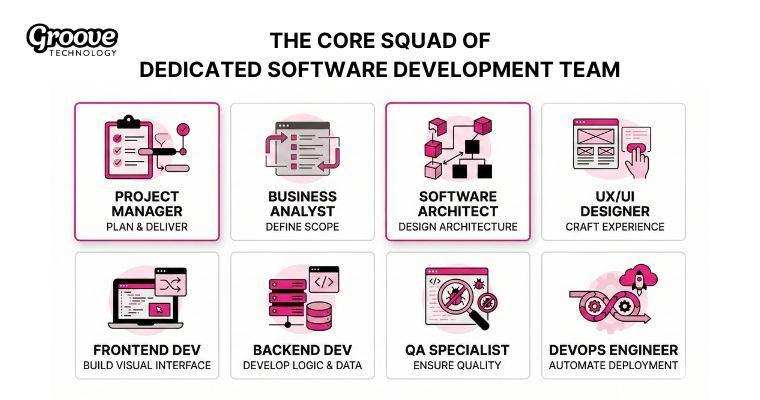
A dedicated software development team typically includes seven core roles: a project manager, a business analyst, a software architect, frontend and backend engineers, a QA specialist, and a DevOps engineer. The exact composition depends on your product’s technical requirements, current stage, and roadmap complexity.
- Project Manager: The project manager drives delivery cadence and owns cross-team communication. This role coordinates sprint cycles, tracks blockers, and keeps the team aligned with your timelines. Without a strong PM, remote teams lose rhythm fast.
- Business Analyst: The business analyst translates business requirements into technical specifications that engineers can act on. They bridge the gap between what stakeholders want and what developers build, reducing rework by clarifying scope before a line of code is written.
- Software Architect: The software architect designs the system structure and guides technical decisions at the foundation level. They select the right architectural pattern, whether monolithic, microservices, or event-driven, and set standards that the whole team follows. Decisions made at this layer affect performance and scalability for years to come.
- Frontend and Backend Engineers: Frontend and backend engineers form the development core of the team and account for the largest share of the budget. Frontend engineers build what users interact with; backend engineers handle the logic, databases, and APIs that power it. Most teams staff two to three engineers per side, depending on workload.
- QA Specialist: The QA specialist protects release quality across performance, security, and usability dimensions. They write test cases, run regression cycles, and catch defects before they reach production. Quality assurance works best when QA is embedded from the start, not added at the end.
- DevOps Engineer: The DevOps engineer automates deployment pipelines, manages CI/CD workflows, and monitors infrastructure health. They reduce deployment risk and cut release cycles from weeks to days. At scale, this role becomes one of the highest-leverage positions on the team.
- UX/UI Designer: The UX/UI designer shapes how users interact with the product and reduces friction across the experience. They work from user research and wireframes through to high-fidelity prototypes, validating decisions before engineering resources are spent building them.
For early-stage products, you do not need all seven roles from day one. Most startups begin with three to four core positions: a project manager, two engineers, and a QA specialist, then add a software architect and DevOps engineer once the product scales and infrastructure complexity increases.
So how does a dedicated software development team work? The dedicated operational model splits responsibilities cleanly between the client and the vendor. The vendor recruits, employs, and retains the engineers. They manage HR administration, provide the infrastructure, and handle local compliance. The client owns everything else: product direction, sprint priorities, tech stack decisions, and process standards. In practice, the team joins your standups, uses your project management tools, and reports to your product lead, operating as if they sit inside your company, regardless of geography.
What is a dedicated application development team?
A dedicated application development team is a focused variant of the dedicated software model assembled specifically to design, build, test, and maintain web or mobile applications. The team focuses on the application layer rather than backend infrastructure, enterprise system architecture, or full-stack platform engineering.
The difference from a fully dedicated software development team lies in scope and composition. A dedicated app development team draws heavily from frontend and mobile specialists: React, Angular, or Vue.js developers for web applications; React Native or Flutter engineers for cross-platform mobile builds; and iOS (Swift) or Android (Kotlin) developers for native applications. UI/UX designers with expertise in mobile design, along with mobile QA testers, round out the team. Backend architects and DevOps engineers appear less frequently and often join as supporting contributors rather than core team members.
A dedicated application development team suits projects where the application layer is the primary deliverable: a SaaS product with an existing backend, a customer-facing logistics mobile app, an e-commerce platform built on Shopify or a headless commerce stack, or a B2B web portal connecting to third-party APIs. If the backend infrastructure already exists and the engineering challenge lies in the interface, performance, and user experience, rather than in the underlying systems, a dedicated app team delivers the right depth without the cost of a full-scope engagement. Both models share the same structural advantages of cost efficiency, scalable capacity, and sustained technical depth.

What Are the Key Benefits of Dedicated Software Development Teams?
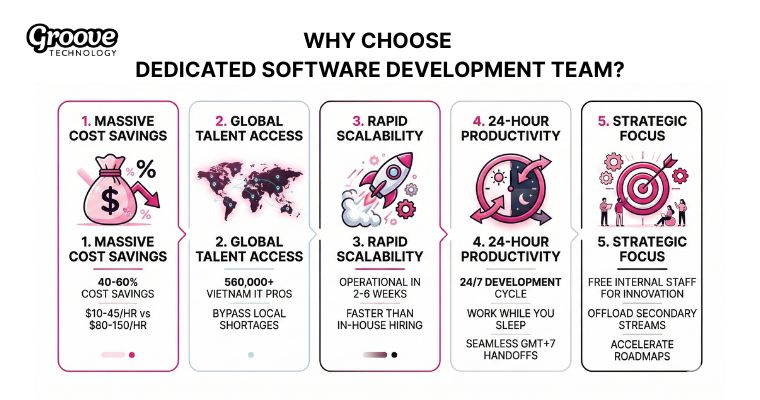
Dedicated software development teams reduce hiring costs by 40–60% (according to Delloite) compared to in-house staffing in the US or the UK, while giving companies direct access to global talent pools, 24-hour development coverage, and scalable engineering capacity, without the overhead of permanent employment. The five benefits below make this model worth understanding in detail.
Cut Staffing Costs Without Cutting Output Quality
A dedicated team based in Vietnam or Eastern Europe delivers comparable technical output at 40–60% of that cost. Hiring a full-time senior developer in the US costs about $128,400 per year, excluding recruitment fees, benefits, and infrastructure, according to ZipRecruiter. Vietnam-based engineers, for example, bill at $10 to $45 per hour (Second Talent, 2024), against typical US contractor rates of $80 to $150 per hour. 59% of businesses outsource primarily to control or reduce operating costs, freeing up capital for product innovation and core operations, according to a Deloitte study.
Tap Into a Global Talent Pool That Local Hiring Cannot Reach
Dedicated teams resolve the constraint of the global IT talent pool by sourcing from markets where technical talent is both abundant and available. The global IT talent shortage makes quality hiring increasingly difficult at the local level. 95% of tech leaders struggle to find qualified engineers, as Robert Half (2024) reported.
In that scenario, Vietnam alone has over 560,000 IT professionals, with universities producing roughly 57,000 graduates per year. The demand for software engineers will grow 25% by 2032, about 8 times faster than the average for all occupations, as the US Bureau of Labor Statistics projects, meaning the domestic talent gap will widen rather than close.
Scale Your Team in Weeks, Not Months
A dedicated team can be assembled and operational in 2 to 6 weeks, faster than any in-house hiring cycle. Groove Technology’s onboarding framework integrates teams directly into existing Agile, Scrum, or Kanban workflows from day one, so engineers contribute from their first sprint rather than spending weeks in ramp-up. This speed matters most when a product roadmap accelerates, and internal capacity cannot absorb new workstreams fast enough.
Extend Your Development Window Across Time Zones
Groove Technology teams based in Vietnam, operating at GMT+7, provide an 8-hour overlap with Australian business hours and a partial overlap with UK and European teams. This arrangement stretches the active development window to 16 hours per day, without requiring anyone to work unsociable hours. The time zone gap, often seen as a liability, functions as a productivity multiplier when handoffs and async communication are structured correctly. Build progress continues while your core team sleeps.
Free Internal Resources to Focus on Core Product Work
When a dedicated team takes ownership of a defined product stream, your internal engineers can concentrate on the platform work only they can do. Companies that route secondary development workstreams to dedicated offshore teams consistently advance their primary product roadmap faster. The outcome is not just cost efficiency, but a structural improvement in how engineering capacity is allocated across the business.
When Should You Hire a Dedicated Software Development Team?
Dedicated software development teams deliver the most value in four specific scenarios: long-term product development with evolving requirements, rapid team scaling under time pressure, projects requiring specialist expertise unavailable locally, and enterprises extending capacity alongside an existing in-house team.
The table below maps common project scenarios to the extent to which the dedicated team model fits each one.
Scenario | Dedicated Team Fit |
| Building a SaaS product from MVP to scale | Excellent |
Short-term bug fix or single feature | Poor |
| Post-Series A startup scaling engineering capacity | Excellent |
Legacy system modernisation | Good |
| One-off UI redesign with defined scope | Poor |
Enterprise team extension alongside in-house developers | Excellent |
A dedicated software development team is not the right model for projects with a fixed scope, a short timeframe, or a clear endpoint. If you need a single deliverable, whether an MVP proof of concept, a single integration, or a one-off feature, a fixed-price project model or staff augmentation will serve you better and cost less. Dedicated teams incur setup time and ongoing monthly costs that yield a positive return only when the engagement runs long enough to absorb them.
For early-stage startups with under 6 months of runway, staff augmentation or a fixed-price MVP is the more practical starting point. Dedicated teams make financial sense once product-market fit is established, and a roadmap exists. At that stage, you know what you are building, roughly how long it will take, and what skills are required over the next 12 to 18 months, which are the conditions that make a dedicated team cost-effective.
Dedicated Software Development Team vs. Staff Augmentation: What’s the Difference?
A dedicated software development team is an external, self-managed product team you engage long-term, while staff augmentation is about adding individual external specialists to your existing team under your own management. Both models draw from the same global talent pools, but they serve different operational needs. Here is how each one works in practice:
- Dedicated software development team: An external provider gives you a stable, pre-assembled team, typically including a PM, developers, and QA specialists, that works for you full-time over months or years. The vendor manages day-to-day delivery and team operations. You steer product vision, priorities, and high-level roadmap; they handle execution.
- Staff augmentation: External professionals, often hired on a per-hour or per-month basis, to fill skill or capacity gaps within your own team. You retain full control over daily tasks, processes, and quality. These individuals work like contract teammates embedded inside your organisation.
The two models diverge across several practical dimensions. The table below captures the most important differences at a glance.
Aspect | Dedicated Development Team | Staff Augmentation |
| What you get | Whole cross-functional team (devs, QA, PM) | Individual specialists or a few roles |
| Management | Vendor manages day-to-day; you own product direction | You manage everything (tasks, code quality, process) |
| Integration | Operates as a separate but aligned unit | Deeply integrated into your existing team and rituals |
| Typical use | Long-term product builds, complex roadmaps | Short-term needs, skill gaps, quick scaling up/down |
| Cost model | Fixed monthly rate for team capacity | Pay per resource/hour, more variable over time |
| Overhead on your side | Lower: 5–10% of your time for requirements and reviews | Higher: 15–25% of the manager’s time per augmented dev |
| Ramp-up | Team is already accustomed to working together | Each hire needs individual onboarding |
| Scalability | Adjust team size in blocks over time | Add or remove specific people and skills granularly |
When does staff augmentation fit better?
Staff augmentation is usually the better fit when:
- You already have strong in-house engineering leadership and established processes.
- You need one to three extra people to cover peaks, such as a new feature release, seasonal load, or a migration sprint.
- You are missing a narrow skill, for example, DevOps, mobile, or a data engineer, for a limited period.
- You want maximum control over architecture, coding standards, and day-to-day work.
For example, your core team can handle most of the product build, but lacks a senior React Native developer for 6 to 9 months. You add one augmented engineer, keep all management and backlog ownership in-house.
When does a dedicated team fit better?
A dedicated team tends to be the stronger choice when:
- You want to build or extend a product over the long term, but do not want to hire an entire in-house team.
- You lack the capacity or appetite to manage many individual external developers on a daily basis.
- You need a predictable monthly cost for a relatively stable team composition.
- You are comfortable letting a vendor run delivery while you focus on product strategy and business outcomes.
For example, you want to build a new SaaS module over two to three years and have no internal engineers to spare. You set up a dedicated team of four developers, one QA specialist, and one PM, who work exclusively on your product from day one.
How Much Does a Dedicated Software Development Team Cost?
The hourly rates for dedicated software development teams typically range from under $25 to over $300 in 2026, with rates varying significantly by location. The table below shows the rate of development hourly through 7 different regions:
Region | Countries | Rates (Hourly) |
Western Europe | Netherlands, UK, Belgium, France, Norway, Germany, Ireland, Sweden, and Switzerland | $50 – $199 |
| Eastern Europe | Ukraine, Bulgaria, the Czech Republic, Hungary, Poland, Romania, Slovakia, Latvia, and Estonia | $25 – $149 |
Central Asia / Western Asia | Kazakhstan, Azerbaijan, Georgia, Armenia, Uzbekistan, and Tajikistan | $25 – $99 |
| East and South Asia | Japan, Indonesia, Malaysia, Philippines, Vietnam, Thailand, and Cambodia | <$25 – $149 |
North America | USA, Canada | $50 – $300 |
| Latin America | Mexico, Colombia, Brazil, and Argentina | $25 – $199 |
Africa | Morocco, Kenya, Nigeria, Egypt, and Ethiopia | <$25 – $99 |
| Australia | Sydney, Melbourne | $50 – $199 |
(Source: Offshore Software Development Rates by Country – Clutch.co)
How Do You Hire a Dedicated Software Development Team?
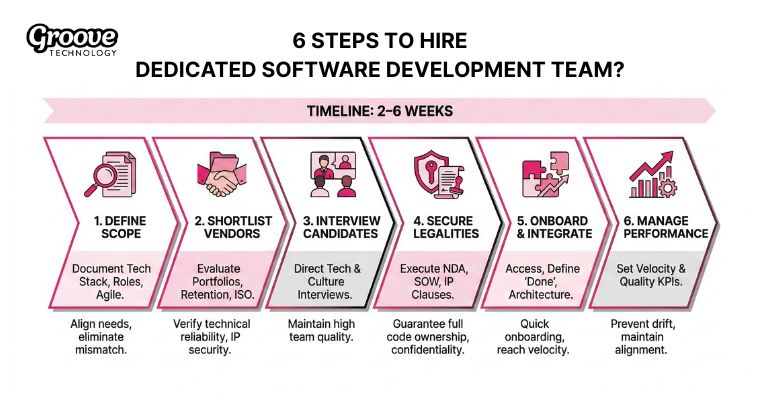
Building a dedicated software development team follows a structured 6-step process, from defining project requirements to team onboarding and performance management. The process typically takes 2 to 6 weeks from first contact to active team delivery, depending on team size and role complexity.
Each step below covers what needs to happen, and why skipping or rushing any one of them increases delivery risk.
Step 1: Define Your Project Scope and Technical Requirements
Clear scope documentation is the foundation on which every vendor assessment and team-assembly decision rests. Before approaching any vendor, document your preferred tech stack, the seniority levels you need for each role, the target team size, the project timeline, and the key deliverables.
You should also define your working methodology, whether Agile, Scrum, or Kanban, and your expected communication cadence. Vendors cannot accurately propose a team composition or quote a realistic cost without this information, and ambiguity at this stage leads directly to mismatched hires and delayed starts.
Step 2: Select a Shortlist of Vendors
Vendor selection is the decision that shapes everything downstream: team quality, communication reliability, and IP security. Evaluate each vendor across five dimensions: technical portfolio in your domain, verifiable client references, engineer retention rates, IP protection policies, and communication standards. Certifications such as ISO 9001 for quality management and ISO 27001 for information security serve as objective benchmarks when comparing vendors.
Groove Technology’s 97% client retention rate and ISO 9001/27001 certifications, for example, reflect the kind of operational consistency worth measuring other vendors against. Aim for a shortlist of three to five vendors before moving to interviews.
Step 3: Interview and Approve Team Members
Candidate interviews give clients direct control over who joins their product team without requiring a full in-house recruitment infrastructure. Reputable vendors provide CV shortlists based on your technical brief, and you interview candidates directly to assess both technical depth and communication fit. This step is non-negotiable. Accepting a team without interviewing its members removes your ability to assess whether the engineers can operate within your product context, your codebase standards, or your sprint rhythm.
Step 4: Establish Legal and IP Agreements
Legal agreements set the boundaries of ownership, confidentiality, and liability before a single line of code is written. At minimum, you need a Non-Disclosure Agreement (NDA), a Statement of Work (SOW) that defines deliverables and acceptance criteria, a data processing agreement if personal data is handled, and explicit IP assignment clauses that transfer code ownership to your company. Do not begin development without these documents fully executed. Retroactive IP disputes are expensive and disruptive, particularly on long-running engagements.
Step 5: Onboard and Integrate the Team
Effective onboarding connects the new team to your tools, communication channels, and delivery cadence from day one. Grant access to your project management platform, version control repositories, documentation systems, and any relevant staging environments. Walk the team through your product architecture, backlog priorities, and definition of done. Most well-structured dedicated teams reach productive sprint velocity within one to two weeks of onboarding. Groove Technology’s onboarding process integrates directly with Agile, Scrum, or Kanban workflows, with no process overhaul required on your side.
Step 6: Set KPIs and Manage Performance
Performance management turns a vendor relationship into a measurable delivery partnership. You need to define sprint velocity targets, code quality benchmarks (such as test coverage thresholds and defect escape rates), communication cadence expectations, and escalation protocols before the first sprint begins. Then, you should review performance monthly against these benchmarks and run a structured quarterly review to assess team composition, velocity trends, and roadmap alignment. Teams that operate without defined KPIs tend to drift in quality and responsiveness over time, particularly past the six-month mark of an engagement.
What Should You Look for in a Dedicated Software Development Partner?
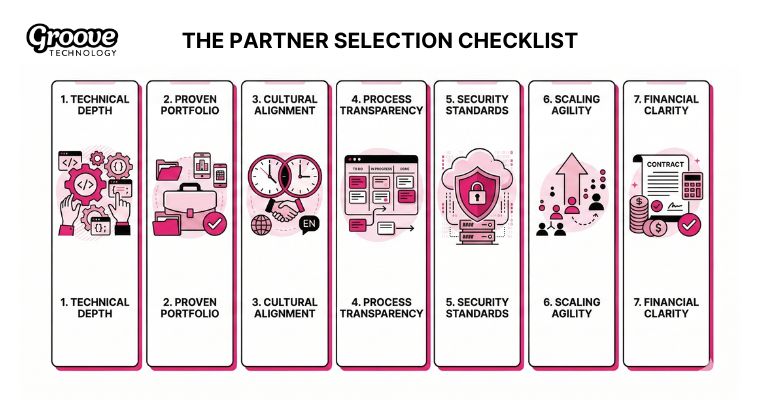
The right dedicated software development partner combines technical depth, operational transparency, and a work culture that integrates seamlessly with yours. The seven criteria below separate reliable long-term partners from vendors that look good on paper but underdeliver in practice.
- Technical Expertise and Experience: You must assess the vendor’s hands-on proficiency with your required tech stack, not just listed skills. Also, if you can, you should review code samples, ask about architecture decisions on similar projects, and confirm they have engineers who have shipped products in your domain, whether that is fintech, e-commerce, healthcare, or SaaS.
- Proven Portfolio and References: Past project quality is the most reliable signal of future delivery consistency. So you should review case studies for technical complexity comparable to your own, then contact previous clients directly to verify communication reliability, how the vendor handled scope changes, and whether they met agreed-upon timelines.
- Communication and Culture: An important thing to notice is to evaluate English proficiency through direct interviews with the engineers who will work on your product, not just the sales team. Check which communication tools they use, how they handle async updates across time zones, and whether their decision-making pace matches your own team’s working style.
- Development Methodology and Transparency: You should look for vendors who run structured Agile or Scrum workflows with visible sprint boards, documented retrospectives, and regular release cycles. A vendor who cannot show you how they manage backlogs, track velocity, or escalate blockers is unlikely to provide meaningful visibility once the engagement begins.
- Security and Compliance: You must examine their data protection policies, infrastructure access controls, and certification status. ISO 27001 certification indicates a formally audited information security management system. For products that handle personal data, confirm the vendor complies with GDPR, HIPAA, or the regulatory framework that applies to your industry.
- Scalability and Flexibility: You need to confirm if the vendor can add or remove team members within a defined timeframe, typically two to four weeks, as your roadmap evolves. Don’t forget to ask specifically how they handle role transitions, knowledge transfer, and bench availability, since a vendor without sufficient talent depth will create bottlenecks the moment you need to scale.
- Pricing and Contract Structure: Another important thing is to look for pricing models that provide cost predictability and clear deliverables, not just the lowest rate. A dedicated team model with a fixed monthly rate per role is easier to budget against than variable hourly billing. So you should review the contract for IP assignment clauses, notice periods, and the treatment of code ownership if the engagement ends early.
Why Choose Groove Technology’s Dedicated Software Development Team?
Groove Technology is an Australian-founded software outsourcing company operating primarily in Vietnam, with 230+ certified engineers and a 97% client retention rate across 120+ completed projects. The company builds dedicated software development teams for SMEs and enterprises across Australia, the UK, and the Asia Pacific, combining Australian management standards with access to one of Southeast Asia’s strongest engineering talent pools.
These four operational commitments separate Groove Technology from generic outsourcing vendors:
- Easy onboarding, compatible with your existing workflow: Groove Technology’s teams integrate directly into Agile, Scrum, or Kanban processes without requiring any changes to how your organisation already operates. Engineers join your standups, work within your backlog tools, and align with your sprint cadence from day one.
- Transparent cost management with no hidden fees: All costs are finalised upfront, with detailed breakdowns provided before any contract is signed. There are no surprise charges for infrastructure, recruitment, or HR administration, and pricing adjusts only when you formally change team composition or scope.
- ISO 9001 and ISO 27001 certifications: ISO 9001 certification confirms a formally audited quality management system applied across every project. ISO 27001 certification confirms that information security controls meet international standards, which matters to clients in regulated industries that handle sensitive data.
- Australian management standards with Vietnamese engineering talent: Groove Technology’s leadership applies Western project governance, communication expectations, and delivery accountability to a team built from Vietnam’s deep engineering talent pool. Clients receive the cost profile of Southeast Asia with the management rigour of an Australian-standard operation.

Companies that need to scale engineering capacity without the overhead of permanent hiring and want a partner with a proven delivery history rather than a standard vendor relationship, can start with a no-obligation discovery call with Groove Technology’s team.
Frequently Asked Questions
Can a dedicated software development team work alongside your in-house team?
Yes, dedicated teams collaborate through shared tools such as Jira, GitHub, or Slack, participate in daily standups, and join joint sprint planning sessions, which allows your internal team to direct priorities while the dedicated team handles execution. This hybrid model gives you full visibility and control over the roadmap without loading your in-house engineers with non-core development work. Cultural silos rarely form when communication cadence and tooling are set up correctly from the start.
Is a dedicated software development team the right choice for startups?
A dedicated software development team is the right choice for startups that have established product direction and a roadmap to execute against. Dedicated teams suit startups that need rapid scaling, access to specialist expertise without lengthy hiring cycles, and lower per-engineer costs compared to local employment. Research from MindIT Systems indicates dedicated teams can accelerate time-to-market by 20 to 40% through pre-vetted, immediately productive talent. For very short engagements or one-off prototypes, freelancers may be a more cost-efficient starting point.
Are dedicated software developers better than freelancers?
Whether dedicated software developers are better than freelancers or not depends on the scope and duration of your project. Dedicated developers outperform freelancers for complex, ongoing work because they bring accountability, continuity, and collaborative depth that solo contractors typically cannot sustain.
Aspect | Dedicated Team | Freelancers |
| Commitment | Exclusive to your project, long-term stability | Juggle multiple clients, higher churn risk |
| Expertise | Deep project knowledge, team collaboration | Broad but shallower, less integration |
| Scalability and Cost | Predictable rates, straightforward scaling | Flexible short-term but unpredictable totals |
What is the minimum team size for a dedicated software development team?
The minimum team size for a dedicated software development team is typically 3-5 members, sufficient for small, simple projects to enable collaboration, code review, and balanced workloads without overload. Smaller than 3 risks being unbalanced and ineffective for team dynamics, while this size allows direct management and transparency.
When should you move on from a dedicated software development team?
You should move away from a dedicated team for short-term, fixed-scope projects (e.g., one-off builds or proofs of concept) where flexibility and long-term continuity add unnecessary overhead. Also consider switching if the project ends without iteration, you build strong internal engineering capacity, or you face issues like stagnation, poor communication, or vendor lock-in. Dedicated models suit evolving products best; rigid needs favor time-and-materials or outsourcing instead.
A dedicated software development team provides businesses with a structured way to scale engineering capacity, access global talent, and maintain product momentum without the overhead of full-time employment. This article covered what these teams are, how they are structured, what they cost by region, when they make sense, and how to hire one. It also outlined how to evaluate vendors and manage performance once a team is in place.
For companies ready to build or expand a product team with experienced engineers, transparent pricing, and a proven delivery track record, Groove Technology offers a no-obligation discovery call to assess your requirements and propose a team structure that aligns with your roadmap.
References:
Delloite 2020 Global Outsourcing Survey https://www.deloitte.com/content/dam/assets-shared/legacy/docs/services/consulting/2022/gx-2020-global-outsourcing-survey-how-much-disruption.pdf
Senior Software Developer Engineer Salary, ZipRecruiter https://www.ziprecruiter.com/Salaries/Senior-Software-Developer-Engineer-Salary
How Much Does It Cost to Hire Software Developers in Vietnam?, Second Talent https://www.secondtalent.com/resources/how-much-does-it-cost-to-hire-software-developers-in-vietnam/
New Robert Half Research Reveals Severity of the Technology Skills Gap Amid Talent Shortage https://newnanceo.com/news/2024/05/new-robert-half-research-reveals-severity-technology-skills-gap-amid-talent-shortage/
Modeled Wage Estimates, The US Bureau of Labor Statistics https://www.bls.gov/mwe/factsheets/mwe-ooh-most-new-jobs-factsheet.htm
Offshore Software Development Rates by Country, Clutch.co https://qubit-labs.com/average-hourly-rates-offshore-development-services-software-development-costs-guide/