


AI-Powered Recommendation Engine: What It Is & How To Work
An AI-powered recommendation engine is an intelligent system that uses artificial intelligence to analyze user data and deliver personalized product suggestions. It transforms raw information such as purchase history and click behavior into relevant recommendations, allowing businesses to predict user needs based on how customers interact with a website or app.
The recommendation process includes core stages such as data collection, storage, analysis, and filtering to produce final results. AI enhances this workflow by processing complex data and identifying hidden behavioral patterns that traditional methods often miss. Through machine learning, the system gains deeper insight into user–item relationships, resulting in more accurate predictions. Studies show that 56% of customers are more likely to return after experiencing personalized shopping.
Depending on business goals, companies can choose collaborative, content-based, or hybrid filtering models. Selecting the right approach enables real-time adaptation, improves conversion rates, and increases average order value. This article from Groove Technology explains how recommendation engines work, highlights common challenges, and presents practical use cases to help you implement the right solution within your digital strategy.
1. What’s an AI-powered recommendation engine?
An AI-powered recommendation system is a specialized software engine that employs machine learning models to examine user data patterns and generate personalized suggestions. Algorithms analyze historical interactions or purchase history to predict exactly what your specific users will value next.
You likely encounter these engines daily when streaming platforms propose new series or online retailers display items related to your recent buys. These intelligent filtering tools process information to connect consumers with relevant goods and keep retention rates high.

2. How do AI-powered recommendation engines work?
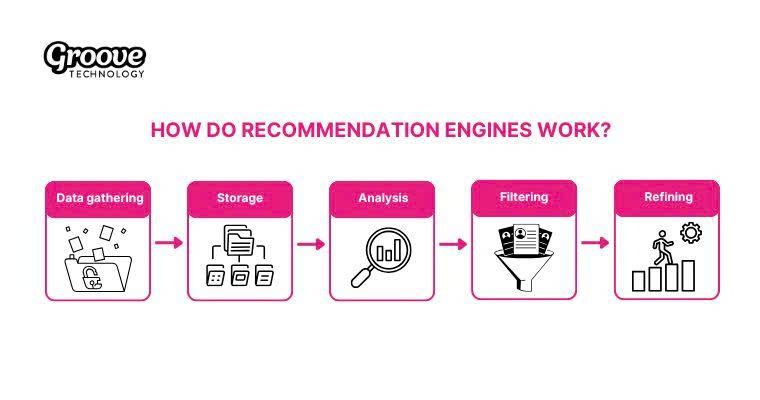
Recommendation engines generally follow a precise 5-step workflow to transform raw user inputs into actionable suggestions.
Step 1 – Data gathering:
Data gathering serves as the foundation of your recommendation system because collecting high-quality information is a crucial first step. The system primarily collects explicit data and implicit data so that you can understand the full spectrum of user intent. Explicit data encompasses active user activities such as comments, likes, and ratings, while implicit data tracks passive behavior like browsing history and clicks to reveal true preferences.
These two data types are necessary because users provide feedback both through direct actions and their natural interaction patterns. Recommenders also use customer demographics and psychographics to find similar users, and feature data helps the engine determine which related products or services fit your specific needs.
Step 2 – Storage:
Storage occurs after your data has been gathered, and the specific architecture you choose depends on the variety of data you collect. Data warehouses aggregate your information from different sources to support complex analysis, while data lakes store both your structured and unstructured data for future use.
A data lakehouse combines the best aspects of both warehouses and lakes into a single management solution so your machine learning models can access the repository easily during the training phase.
Step 3 – Analysis:
The analysis phase employs machine learning algorithms to process and examine your datasets. These algorithms detect patterns and identify correlations because machine learning models can handle large volumes of data to make fitting recommendations for your audience. The engine weighs the strength of these patterns to predict exactly what your specific customers will likely value next.
Step 4 – Filtering:
Filtering acts as the final step where the system shows you the most relevant items from the previous analysis. Data filtering involves applying mathematical rules and formulas to your data because each type of recommendation engine requires a specific logic to rank results. This stage selects only the items with the highest probability of engagement for your website or app interface.
Step 5 – Refining:
Refining provides an optional but valuable step where you regularly assess the outputs of your recommendation system. This feedback loop optimizes your model to continually enhance its accuracy and quality so your suggestions remain relevant to your users over long periods.
3. How does AI improve a recommendation engine?
Artificial intelligence transforms standard recommendation engines into an AI-powered recommendation engine by applying five distinct mechanisms that drive better results.
- Pattern identification: Machine learning algorithms scrutinize user behavior data like clicks to detect latent preferences. These engines use collaborative filtering to find complex patterns across large datasets for better accuracy.
- Complex representation: AI systems process multi-dimensional features from user sessions and item characteristics using deep learning models. Embeddings transform categorical data into vectors to model intricate relationships for future preferences.
- Relationship modeling: Recommendation models understand how users and items relate through multi-faceted analysis of profiles and metadata. Predictive modeling identifies complementary products and seasonal needs that manual analysis might overlook.
- Dynamic prediction: The system adapts continuously by learning from evolving user behaviors and recent browsing trends. Behavioral signals contribute to high-precision forecasts that anticipate what your specific users want next.
- Scope expansion: AI tailors suggestions by considering subtle preference signals to offer relevant items consumers might miss. This personalization helps users discover new products while increasing overall engagement and customer loyalty.
4. How can an AI-powered recommendation engine increase your sales?
Your online store transforms into a personal shopper for every visitor when you use a solid AI engine. Data shows that nearly half of US shoppers in 2023 specifically wanted personalized suggestions, while 56% returned to merchants who offered customized experiences. This technology does more than just sell; it builds retention by making your customers feel understood through tailored interactions.
A recommendation engine drives revenue growth through 3 specific mechanisms.
- Streamlined discovery: Customers see relevant choices immediately because the system surfaces exactly what they need. Your visitors stop scrolling endlessly and start buying faster since they find their desired items without frustration.
- Higher average order value: Checkout pages become revenue boosters when you add sections like “Frequently bought together.” Smart upsells and cross-sells encourage shoppers to add more to their carts and increase their total spend.
- Enhanced customer loyalty: Shoppers return to your store because they enjoy the speed and personal touch. A tailored experience proves you value their time and understand their preferences better than competitors.

5. Three types of recommendation engines
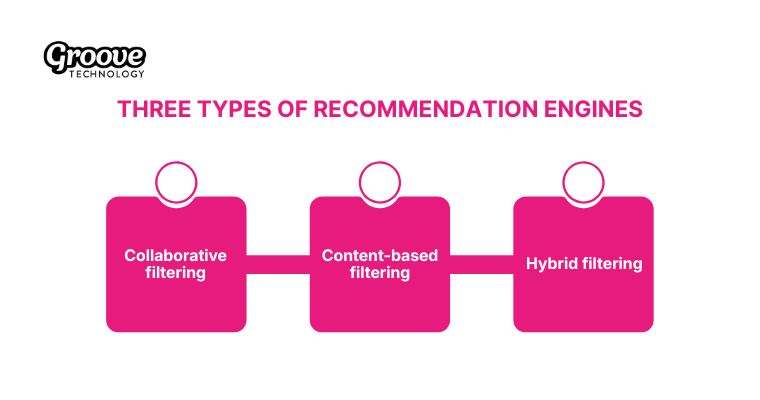
An AI-powered recommendation engine typically relies on three core models: collaborative filtering, content-based filtering, and hybrid filtering models to sort information.
Collaborative filtering
Collaborative filtering recommender engines collect and analyze data on people’s behavior, activities, and preferences. The system predicts what users will like based on their actions’ similarity to those of other users, assuming that people who agreed in the past will likely agree in the future.
Engineers typically deploy 2 distinct approaches when implementing collaborative filtering systems.
- Memory-based filtering: The system identifies clusters of similar users and uses their interactions to predict actions, though sparse data matrices can sometimes hinder the generation of high-quality clusters.
- Model-based filtering: Machine learning and data-mining techniques train predictive models to recommend items to more people, often utilizing algorithms like matrix factorization or hybrid methods depending on the data set’s nature.
Collaborative filtering does face a cold-start problem when a new user or product arrives without history. You can decrease this lag time by asking users for data upon sign-up, then pair that with available item metadata to relate the new user to existing items.
Content-based filtering
Content-based filtering groups similar products together by analyzing specific features and attributes, such as product type, color, word length, or genre. Algorithms weigh user preferences against these item descriptions to find matches, effectively telling you that because you liked one specific thing, you might enjoy this related item too.
This method does have 3 specific drawbacks that limit its effectiveness in certain scenarios.
- Limited insight: The engine only recommends items similar to what a user has already viewed or bought, which restricts discovery.
- Category restriction: A user interested in specific categories will not receive recommendations from others, as the system cannot cross-reference interests reliably.
- New user data: New arrivals to a site or app provide no behavioral data, leaving the system with nothing to base predictions on.
Hybrid filtering
Hybrid recommender systems utilize both collaborative and content-based data to create a superior filtering workflow that produces the best suggestions. Netflix serves as a great case study of a company doing it all, as it improves customer experience by accounting for subscribers’ interests using collaborative filtering and for movie descriptions using content-based filtering.
6. Benefits of AI-powered recommendation engines
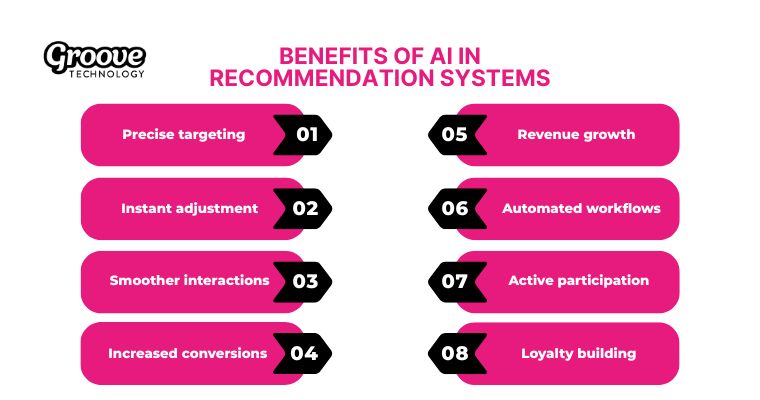
The benefits of AI in recommendation systems include 8 distinct mechanisms that improve your platform and drive higher user satisfaction because intelligent algorithms handle data more effectively than manual methods.
- Precise targeting: AI identifies subtle behavioral patterns and accurately predicts individual needs, creating highly personalized experiences. In retail, it recommends products that match personal style, while entertainment platforms suggest content aligned with current moods and preferences.
- Real-time adaptation: Recommendations update instantly as users interact, ensuring relevance at every touchpoint. For example, travel apps adjust flight or hotel suggestions based on recent searches, reflecting current plans and priorities.
- Smoother user experiences: By filtering out irrelevant information, AI reduces choice overload and highlights what truly matters. Digital banking apps, for instance, prioritize the most relevant financial services, allowing users to complete daily tasks more efficiently.
- Higher conversion rates: Machine learning models pinpoint items users are most likely to purchase or subscribe to at the right moment. High relevance encourages faster decision-making and turns casual visitors into paying customers.
- Revenue growth: Intelligent recommendations enable effective cross-selling and up-selling strategies. In e-commerce, suggesting compatible accessories during checkout adds value for users while increasing average order value and overall sales.
Automated workflows: AI manages content personalization for millions of users simultaneously, eliminating the need for manual intervention. Businesses reduce operational costs while scaling marketing efforts with consistent accuracy. - Stronger engagement: Relevant content keeps users active on the platform for longer periods. Social media feeds leverage this by prioritizing posts from favorite creators, reducing churn and boosting daily engagement.
- Customer loyalty: Consistent personalization makes users feel understood and valued by the brand. Over time, ongoing satisfaction builds trust and strengthens long-term relationships, encouraging customers to remain loyal for years.
7. Challenges of using AI-powered recommendation engines
The challenges of using AI recommendation engines involve 6 distinct obstacles that you usually encounter when you deploy these intelligent systems in a live environment.
- Infrastructure investment: Infrastructure investment creates a major hurdle because training deep learning models on massive datasets requires expensive hardware and specialized technical talent. Large retailers often face high costs when building these systems from scratch, but cloud-based AI services allow your business to rent the necessary power and reduce your upfront spending significantly.
- System latency: System latency occurs when your engine takes too long to process data during an active user session. Mobile apps and high-traffic websites require split-second response times to keep your visitors engaged, so software developers use edge computing and optimized database queries to deliver your suggestions without any annoying delay.
- Discovery limitation: Discovery limitation happens when algorithms suggest items that you have already seen or create narrow feedback loops that restrict variety. News platforms and video services might show you the same content types repeatedly, but smart algorithms solve this issue by using exploration techniques that inject new and unexpected topics into your personal feed.
- Visitor ambiguity: Visitor ambiguity affects your engine because new visitors lack the interaction history needed to generate accurate suggestions right from the start. First-time shoppers on your website often see generic results because the system knows nothing about their preferences, so your business should use location data or trending product lists to provide immediate value until the visitor shares more personal signals.
- Product dormancy: Product dormancy keeps your fresh items hidden because they do not have enough historical data to appear in behavioral recommendations. New fashion arrivals or recently uploaded videos often struggle to gain visibility, but content-based filtering helps your business promote these items by analyzing their attributes instead of waiting for user clicks.
- Interaction scarcity: Interaction scarcity makes it difficult for your algorithms to identify similar users because the dataset contains many empty spaces or missing feedback. Niche marketplaces for luxury goods or professional services often suffer from low transaction volumes, but hybrid models solve this challenge by combining behavioral data with product features to build a more complete recommendation profile for your customers.
8. Use cases for AI-powered recommendation engines
AI-powered recommendation engines are being applied in five specific areas where intelligent suggestions make a real difference in daily operations.
- E-commerce and retail: Retailers drive revenue by suggesting items that complement what a shopper just bought. Amazon uses this strategy to promote new products or bundle seldom-bought items with popular ones for better reach.
- Media and entertainment: Streaming platforms analyze historical data to present the next TV series or song you will likely enjoy. Companies like Netflix and Spotify rely on these systems to keep you watching and listening longer.
- Travel and hospitality: Booking engines suggest accommodations and local experiences that fit perfectly within a traveler’s budget and history. These personalized trip options directly improve satisfaction by meeting specific needs before the customer even asks.
- Marketing: Marketing teams expand qualified leads by pushing relevant blogs, case studies, or webinars to prospective clients. You can deliver these targeted suggestions through newsletters or social media ads to capture interest immediately.
- AIOps: IT operations teams automate complex workflows by using engines that suggest immediate technical solutions. This application helps your staff respond swiftly to issues and keeps your digital infrastructure running smoothly without manual interference.

9. Top 5 AI-powered recommendation engine
These are the top 5 proven engines that can help you accelerate the development process of your platform.
- Amazon Personalize (AWS): This fully managed service uses deep learning to generate real-time suggestions based on user behavior and metadata. The system scales automatically to handle massive e-commerce datasets while maintaining low-latency predictions for users.
- Google Recommendations AI: This cloud-integrated tool leverages Vertex AI to support diverse retail and media use cases through collaborative filtering. Its architecture handles cold starts effectively and integrates seamlessly with existing Firebase deployments.
- Microsoft Azure Personalizer: This reinforcement learning service optimizes outcomes by learning from user feedback in real-time for adaptive applications. The platform supports multi-objective optimization and connects easily with your existing Azure ecosystem.
- Algolia Recommend: This search-enhanced engine combines neural networks with filtering to provide instant, relevant suggestions for speed-focused sites. Developers appreciate the high customizability and free tier options available for smaller e-commerce projects.
- Dynamic Yield: This comprehensive platform provides personalization across channels using hybrid models for web, apps, and email campaigns. Marketing teams value the user-based pricing and specialized tools like tailored push notifications.
This guide explained the mechanics of an AI-powered recommendation engine, covering data analysis, benefits, and filtering types. You gained insight into how specific algorithms drive sales and improve user retention, so you can confidently select the right model for your platform.
Groove Technology stands ready to help you implement these sophisticated tools. Our Australian-owned company connects global businesses with high-performance software teams in Vietnam. We deliver tailored strategies through AI and Machine Learning, AI Solutions Outsourcing, and AI Data Analytics Solutions to support your technical excellence and sustainable growth.

