


What is AI-powered fraud detection? Why do financial companies use AI for fraud detection?
AI-powered fraud detection uses machine learning algorithms to analyze vast amounts of data in real-time to identify scams. The software instantly detects fraudulent activities, such as payment fraud and identity theft, to prevent financial loss. As cybercriminals rely on automation to bypass traditional security measures, banks need AI because manual rule-based systems can no longer keep pace.
The solution monitors transactions through behavioral analysis while learning from historical data to detect anomalies and reduce false positives. With strong scalability and rapid adaptation to new threats, AI significantly improves detection speed and accuracy by uncovering risk patterns that humans may overlook.
This guide from Groove Technology will provide an overview of AI fraud detection, explaining why companies adopt it, how it works, its benefits, challenges, differences from traditional methods, as well as implementation strategies and real-world examples to show how AI secures financial platforms.

1. What is AI-powered fraud detection?
AI Fraud Detection refers to the use of artificial intelligence and machine learning algorithms to identify suspicious patterns, behaviors, and anomalies that may indicate fraudulent activity, enabling businesses to stop fraud before it causes real damage. Unlike rule-based systems, AI-driven solutions continuously learn from new data, improving their accuracy over time while adapting to the constantly evolving tactics of modern fraudsters.
This technology analyzes massive volumes of real-time data, including transaction histories, user behavior, device fingerprints, and contextual signals. As a result, AI can uncover subtle correlations and hidden fraud patterns that human analysts or manual review processes are likely to overlook. This capability has become a critical advantage in today’s digital-first environment.
As digital transactions continue to grow rapidly, manual fraud review simply cannot keep pace with the scale and sophistication of modern fraud attempts. Compounding the challenge, fraudsters themselves are increasingly leveraging AI-powered techniques. However, with every transaction processed, AI-powered fraud detection systems become more precise and resilient, as each event is evaluated against historical data and proven risk models. This allows organizations not only to respond faster to threats, but also to build a scalable, long-term fraud prevention strategy grounded in data and continuous learning.

2. Why do companies use AI for fraud detection?
Today’s cybercriminals rely on automated tools to crack passwords and bypass security layers in just seconds. Faced with this speed and scale, manual control systems are no longer effective. That is why many banks across the U.S. and Europe have adopted AI-powered fraud detection to identify, prevent, and block fraudulent activities in real time.
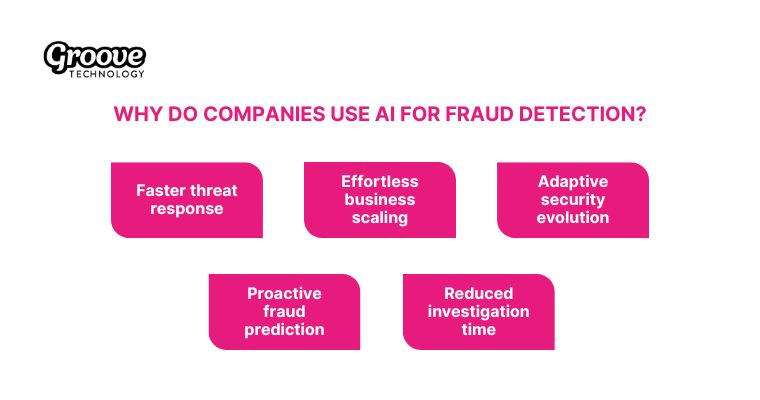
Below are five core reasons why machine learning has become essential in combating modern financial threats:
- Faster threat response: The system reacts in milliseconds, helping you stop fraud immediately before damage escalates.
- Proactive fraud prediction: Algorithms identify patterns that signal potential attacks and prevent breaches even before obvious signs appear.
- Effortless business scaling: Artificial intelligence handles increased data volumes and complexity without causing the typical scaling issues of manual reviews.
- Reduced investigation time: The software processes large datasets quickly and pinpoints the exact cause of fraud or a system weakness.
- Adaptive security evolution: Machine learning models constantly learn and adapt to new tactics while traditional methods quickly become outdated.
3. How does AI detect financial fraud?
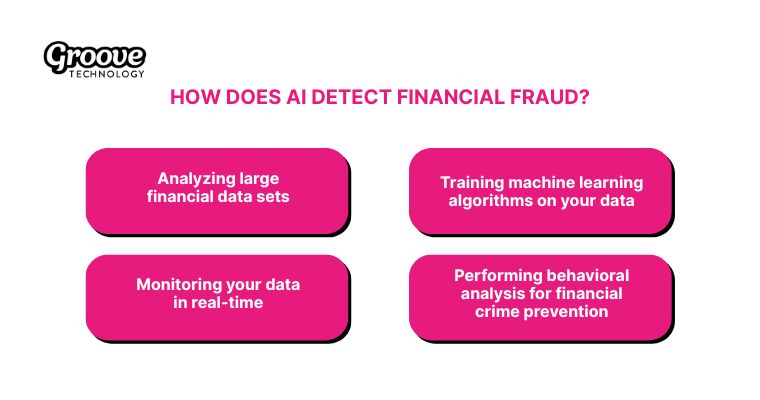
AI-powered fraud detection relies on four core mechanisms to secure financial assets: analyzing massive datasets, monitoring real-time feeds, training self-learning models, and performing deep behavioral analysis.
Analyzing large financial data sets
Financial systems process massive amounts of critical data daily, so you need systems that handle this workload with high accuracy and zero human error. Artificial intelligence processes millions of transactions, user activities, and digital documentation simultaneously because its capabilities extend beyond simple speed to deep analytical depth.
For example, Graph Neural Networks scan millions of historical transactions at once to uncover money laundering schemes. The software detects when criminals split large sums into thousands of tiny transfers across unrelated accounts (known as layering) which is a pattern too vast and fragmented for human analysts to spot manually.
Monitoring your data in real-time
AI watches transactions in real time as they occur, so you can take the necessary action during the fraud attempt instead of fixing the mess afterward. Your developers can use multiple APIs and event triggers to connect and monitor financial data instantly, including login attempts and account activities.
For example, the system instantly flags “impossible travel” if you buy coffee in New York and five minutes later, your card is used in London. Algorithms calculate the physical distance and time between transactions in milliseconds and automatically decline the fraudulent charge before funds leave the account.
Training machine learning algorithms on your data
Fraudsters constantly develop new techniques, while traditional rule-based systems struggle to keep up due to manual updates. In contrast, machine learning models continuously learn from your organization’s historical data.
By analyzing past fraud incidents, these models identify emerging patterns and build predictive capabilities rather than simply reacting to known threats. For instance, a merchant can train an AI model on historical false refund claims to detect “friendly fraud.” The system learns business-specific signals (such as suspicious email domains or rushed checkout behavior) and automatically flags similar high-risk orders in the future.
Performing behavioral analysis for financial crime prevention
Instead of evaluating transactions in isolation, AI tracks user behavior over time. The system quickly detects anomalies, such as a customer who normally logs in from one city suddenly accessing the account from another country.
Even if attackers obtain the correct password, AI can still stop them by analyzing behavioral signals. The software detects irregularities, such as typing much faster than the legitimate user typically does, and locks the session to prevent unauthorized access.
4. Benefits of AI-powered fraud detection in finance
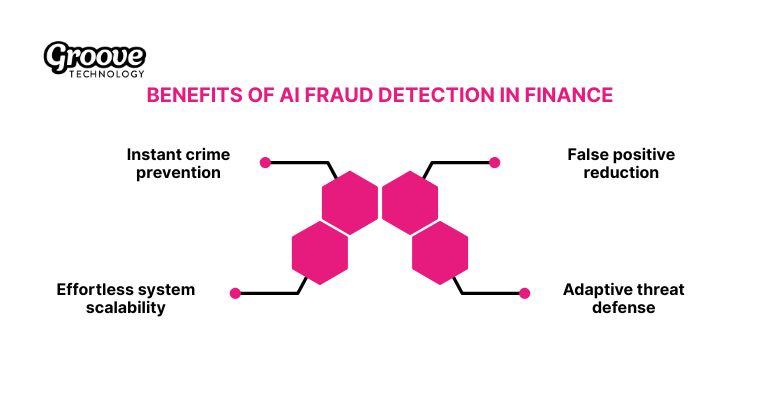
Implementing these intelligent systems brings four distinct advantages to your software infrastructure and security protocols.
- Instant crime prevention: The software analyzes user behavior instantly and flags anomalies like unusual spending before damage occurs. This speed prevents escalation because the system blocks suspicious activities in milliseconds while minimizing financial impact.
- False positive reduction: Machine learning models distinguish legitimate actions from fraud and cut false alarms by nearly 90%. Neural networks detect subtle patterns missed by static rules so your genuine customers avoid unnecessary disruptions.
- Effortless system scalability: Your company manages more transactions and data volume automatically as business operations grow. Artificial intelligence handles these increased loads without the major adjustments or manual interventions required by traditional legacy systems.
- Adaptive threat defense: Artificial intelligence learns from fresh transaction data and adjusts its detection methods in real time against new schemes. The system identifies emerging patterns, such as unusual purchase locations, as it evolves alongside modern financial crimes.
5. Challenges of AI-powered fraud detection in finance
The challenges of AI fraud detection are five distinct obstacles that you will likely face because the implementation of these advanced systems is a complex journey and you must navigate several technical hurdles to ensure success:
- High financial investment: The initial setup strains budgets because you need specialized infrastructure and skilled engineers. Continuous model updates increase long-term costs, as the software requires constant tuning to remain effective.
- Data quality issues: AI models require vast and clean datasets to function accurately. Fragmented legacy data leads to poor performance, and biased training inputs can lead to discriminatory outcomes that violate strict compliance regulations.
- Evolving adversarial threats: Criminals utilize their own AI tools to generate deepfakes or behavior-mimicking bots. Your systems struggle against these zero-day attacks without constant retraining because standard models often fail to spot novel patterns.
- Difficult system integration: Legacy banking systems resist modern AI integration and often require costly API overhauls. Operational disruptions occur during rollout because the technical gap between modern algorithms and legacy infrastructure complicates connectivity.
- Complex regulatory compliance: Sensitive data handling poses privacy risks, necessitating strict encryption and anonymization. Opaque “black box” models hinder the explainability required for audits, so legal teams often struggle to account for AI decisions.
6. The difference between traditional and AI-powered fraud detection
The fundamental distinction lies in the decision-making process itself. Legacy systems rely on static rules and human intuition, so they follow a rigid linear logic structure. Artificial intelligence, however, ingests massive datasets to recognize hidden patterns that human analysts might miss. While rule-based methods function simply during setup, machine learning models actively learn and adapt to new tactics in real time.
This comparison table highlights the specific operational strengths and weaknesses of both approaches.
| Feature | Traditional Fraud Detection | AI-Powered Fraud Detection |
| Primary Method | Rules-Based & Human Intuition: The system uses “If X, then Y” logic and relies on analysts’ domain experience to verify legitimacy. | Pattern Recognition: Algorithms analyze complex interactions between vast data points to see the “bigger picture.” |
| Scalability | Limited: The software struggles to process high transaction volumes quickly because scaling requires hiring more expensive specialists. | Massive: The technology automates analysis in real-time and handles data volumes far greater than any human team could manage. |
| Accuracy | Lower (High False Positives): Rigid rules often flag legitimate unusual behavior (like a one-time large purchase) as fraud and annoy customers. | Higher (Contextual): The model identifies anomalies with better precision by analyzing context and reduces unnecessary transaction blocks. |
| Adaptability | Static: The defense remains restricted to the specific rules programmed into the system. | Continuous Learning: The system gets smarter over time and automatically adapts to catch new, evolving types of fraud. |
| Implementation | Simple: Your team can execute this easily using well-established, standard protocols. | Complex: The process requires deep integration, significant initial investment, and the curation of high-quality training data. |
7. Strategy to build an AI fraud detection
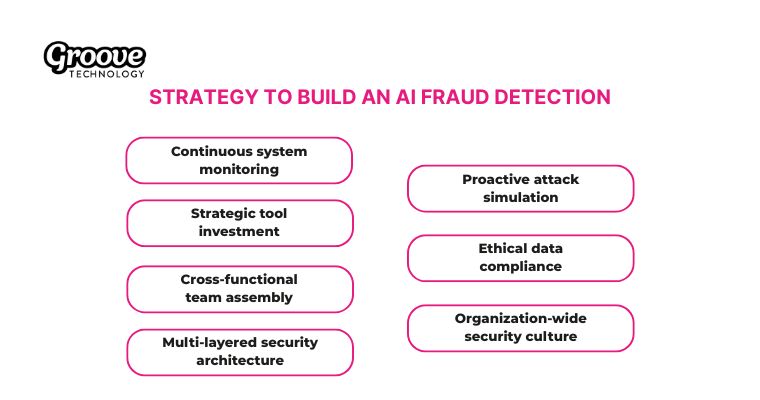
Building an effective AI-powered fraud detection system requires more than just code; it requires a holistic plan that involves people, processes, and technology. You need a clear plan to succeed, so here are 7 specific strategies to build a resilient defense system:
- Cross-functional team assembly: Your business needs experts from IT, legal, and operations to align prevention efforts with business goals. This collaboration guarantees technical specialists and business stakeholders understand customer behavior and operational requirements together.
- Continuous system monitoring: Your developers must implement a systematic approach to analyze fraud patterns and update detection models frequently. This maintenance keeps the system effective against threats and adapts it to changing customer behaviors.
- Multi-layered security architecture: Artificial intelligence works best when combined with other measures, such as multi-factor authentication and device fingerprinting. This layered defense creates multiple barriers that criminals must overcome and reduces the likelihood of successful attacks.
- Strategic tool investment: Your company should select software that aligns with specific business needs in terms of accuracy, real-time response, and integration capabilities. The right technology provides effective protection while it minimizes operational overhead and customer friction.
- Ethical data compliance: Your policies must respect user privacy through transparent collection and secure storage of sensitive information. Ethical practices ensure regulatory compliance with laws such as GDPR and build customer trust in your security measures.
- Proactive attack simulation: Your security team should test the system regularly through simulated attacks to find weaknesses before criminals exploit them. These exercises provide valuable insights for improvement and identify vulnerabilities that internal teams might overlook.
- Organization-wide security culture: Leaders must build awareness throughout the organization so every employee understands their specific role in prevention. This mindset helps prevent social engineering attacks and integrates security considerations into all daily business processes.
8. Use cases for AI-powered fraud detection
Financial institutions apply these algorithms across many sectors, but these 3 specific implementations show the technology at its best.
- Cryptocurrency tracing: The software monitors blockchain transactions to identify unusual behaviors, such as rapid fund transfers. This tool tracks stolen assets through the decentralized ledger because fraudsters favor crypto for its perceived anonymity.
- Verification chatbots: These intelligent assistants analyze language patterns during conversations to identify potential phishing attempts. The bot flags identity thieves based on known markers because it understands context better than simple scripts.
- Ecommerce defense: Banks use AI systems to analyze purchase history and device location to detect anomalies in real time. Computer vision also scans website interfaces to warn users about disreputable shops before they pay.

9. The history of AI in fraud prevention
The technology didn’t appear overnight, and looking back at these 3 key developmental phases reveals how far the industry has come.
- Early rule systems: Banks relied on static logic frameworks in the 1990s before adopting basic statistical models. These systems analyzed historical data patterns because security teams needed a shift away from rigid, manual reviews.
- Machine learning integration: Algorithms began processing massive datasets in the 2010s to study user interactions across different platforms. This shift prioritized adaptability and reducing false positives, as criminals began changing their tactics more frequently.
- Modern deep learning: Deep neural networks now analyze hundreds of signals, such as device fingerprints, instantly to stop sophisticated attacks. Generative AI tools effectively counter these AI-powered threats as the global market value continues to expand.
This guide explained how AI-powered fraud detection safeguards financial systems and why banks must adopt it. We covered the technical mechanics, distinct benefits, and the necessary strategies to counter modern threats. You now understand the tools needed to secure your digital infrastructure.
Groove Technology stands ready to be your strategic partner. We are an Australian software company founded in 2016 with operations in Vietnam. Our teams provide high-performance AI Solutions Outsourcing, AI Agent Solutions, and AI Data Analytics Solutions for clients in Australia, Asia, and Europe. We deliver the technical excellence and innovation your growth requires.

